
Last updated: 2026-11-12
Every Afternoon, My Head Tightens Like It's Wrapped in a Band
An office worker in their 40s feels both sides of the head tighten like a band, from the forehead to the back of the head, around three or four o'clock every afternoon. Each time, a painkiller taken from the desk drawer eases it for an hour or two, but the same headache returns the next afternoon, and before long the days on which they take a painkiller have passed ten a month. When the head tightens every afternoon like this and the pain comes back once the medication wears off, tension-type headache should first be told apart from migraine, cervicogenic headache, and occipital neuralgia, and treatment should be approached in two separate parts: preventive treatment for the headache itself, and treatment for the stiff muscles at the back of the neck and in the shoulders.
In many cases, the back of the neck and the shoulders are already hard and stiff, and hurt when pressed by hand, before the headache fully sets in. A painkiller eases that day's headache for a while, but the stiff muscles at the back of the neck and in the shoulders stay as they are. That is why the tightening pain returns the next afternoon. For fascia at the back of the neck and in the shoulders that has stiffened from tension like this, we apply extracorporeal shockwave therapy (ESWT) to release the knotted spots.
If both sides of the head tighten like a band and everyday movements such as walking or climbing stairs do not make the pain worse, this is the typical pattern of tension headache (tension-type headache). Tension-type headache is the most common neurological disorder in the world; its pain is mild to moderate in intensity, and it characteristically presses or tightens on both sides of the head (Ashina S et al., 2021). Diagnosis starts with taking a history, asking how the pain began and how it has continued, and then an examination rules out a headache that arises from another cause.
When the Back of the Neck and the Shoulders Stiffen, Why Does the Head Hurt Too?
When tension-type headache first begins, peripheral causes such as the muscles around the head and neck are involved. But when an occasional headache turns into a chronic headache that continues almost every day, central sensitization is involved, in which the nervous system that transmits and perceives pain becomes oversensitive (Ashina S et al., 2021). In other words, as pain signals keep coming from the neck and shoulder muscles, the nervous system gradually becomes more sensitive and headaches become more frequent.
In fact, a study of 797 people from the general population found that the share who had neck pain in the past year was 56.7% among people without headache, but reached 88.4% among people with tension-type headache alone (Ashina S et al., 2015). The same study rated how much the muscles around the head hurt when pressed by hand as a tenderness score. As a result, people with accompanying neck pain scored 15.1 points, clearly higher than the 8.4 points of people without neck pain.
A spot in a tightly knotted muscle where pressing sends pain not only to that site but also to a distant area is called a trigger point. One study pressed and compared the upper shoulder muscle (upper trapezius) in 20 patients with chronic tension-type headache and 20 people without headache. Most of the patients felt the pain spread past the side of the neck up to the temple, while none of the people without headache had pain spreading to the temple (Fernández-de-Las-Peñas C et al., 2007).
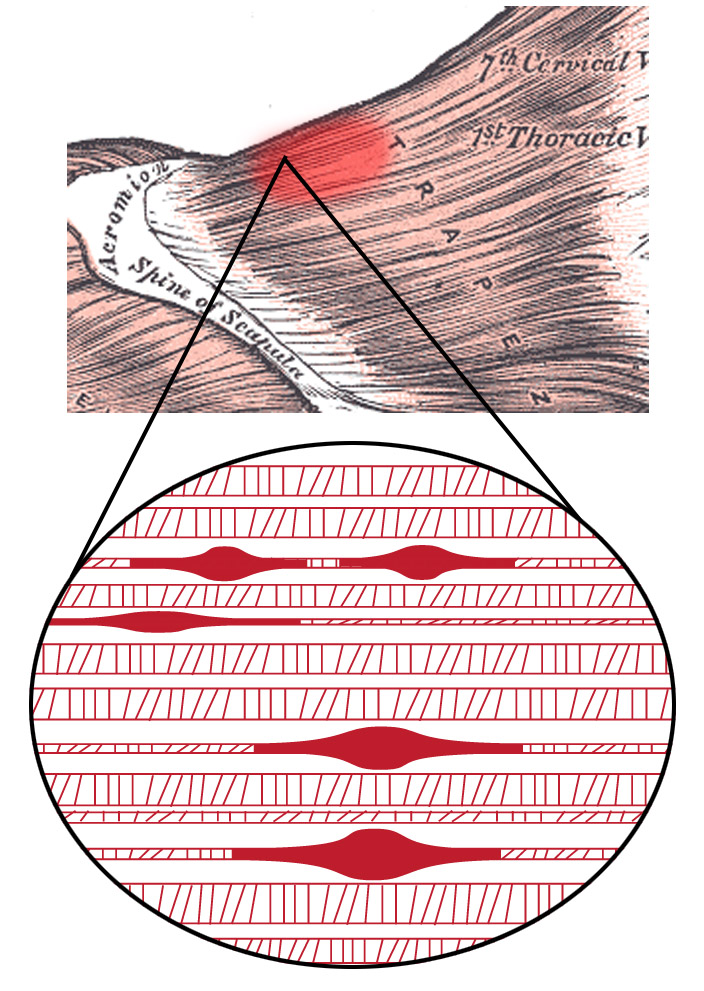 A trigger point in the upper trapezius, with a close-up of the muscle fibers showing some fibers thickened into a spindle shape (Davidparmenter, CC BY-SA 3.0)
Moreover, 45% of the patients in this study said that the pain spreading up when the upper shoulder muscle was pressed was the same as the headache they usually had. And when these trigger points were present, their usual headaches were more severe, came more often, and lasted longer once they started. Sitting for long hours looking at a monitor screen, long drives, an excessive workload, lack of sleep, and stress are common triggers that tense the muscles at the back of the neck and in the shoulders and bring on tension-type headache.
If You've Been Taking Painkillers on More Than Ten Days a Month
When tension-type headache comes only occasionally, simple painkillers are used as the first-line medication to reduce acute pain. However, taking painkillers regularly or often every time the head starts to tighten can instead increase the number of days with headache, and an occasional headache may turn into a chronic headache or medication-overuse headache (Diener HC et al., 2019).
Medication-overuse headache affects 1–2% of the general population over a year. It is more common in women, in people with depression or anxiety, and in people who also have chronic pain elsewhere in the body. Because the medication taken to stop the pain paradoxically makes the next headache easier to set off, anyone taking painkillers on more than ten days a month should see a doctor rather than taking more medication on their own.
Treatment for medication-overuse headache follows three approaches: counseling and education so that acute painkillers are taken less often, stopping the overused medication in some patients, and, when needed, adding preventive headache medication and non-drug preventive treatment. Even before reaching the stage of medication overuse, preventive treatment that reduces how often the headache occurs is considered for frequently recurring episodic or chronic tension-type headache, or when simple painkillers do not work well enough (Ashina S et al., 2021).
How Is It Different from Migraine, Cervicogenic Headache, and Occipital Neuralgia?
To properly solve why your head hurts every afternoon even after taking painkillers, tension-type headache first has to be told apart from other headaches. Tension-type headache tightens both sides of the head like a band, does not get worse with walking or climbing stairs, and rarely comes with nausea. The diagnosis is made by taking a history and checking for tenderness and neurological abnormalities (Ashina S et al., 2021).
Migraine, by contrast, usually throbs on one side of the head in time with the pulse, gets noticeably worse with everyday movement, and comes with nausea or sensitivity to light and sound. Cervicogenic headache always affects the same side of the head, and its hallmark is that turning the neck in a certain direction or pressing on the back of the neck by hand reproduces the usual headache exactly. Occipital neuralgia, in turn, causes a sharp, zapping pain at one spot on the back of the head, like an electric spark.
As we saw earlier, tenderness when the neck and shoulders are pressed is also very common with tension-type headache. So a stiff, achy back of the neck alone is not enough to conclude that the headache is cervicogenic headache starting from the neck. At Guri Top Bone Clinic, a board-certified neurologist sees patients, and when a headache rises from the back of the neck, we perform electromyography (EMG) and nerve conduction studies to check, through electrical responses, whether a neck nerve is compressed. When a vascular cause needs to be ruled out, we use transcranial Doppler (TCD) ultrasound to measure the blood flow velocity in the vessels leading to the brain and look for any narrowed segment.
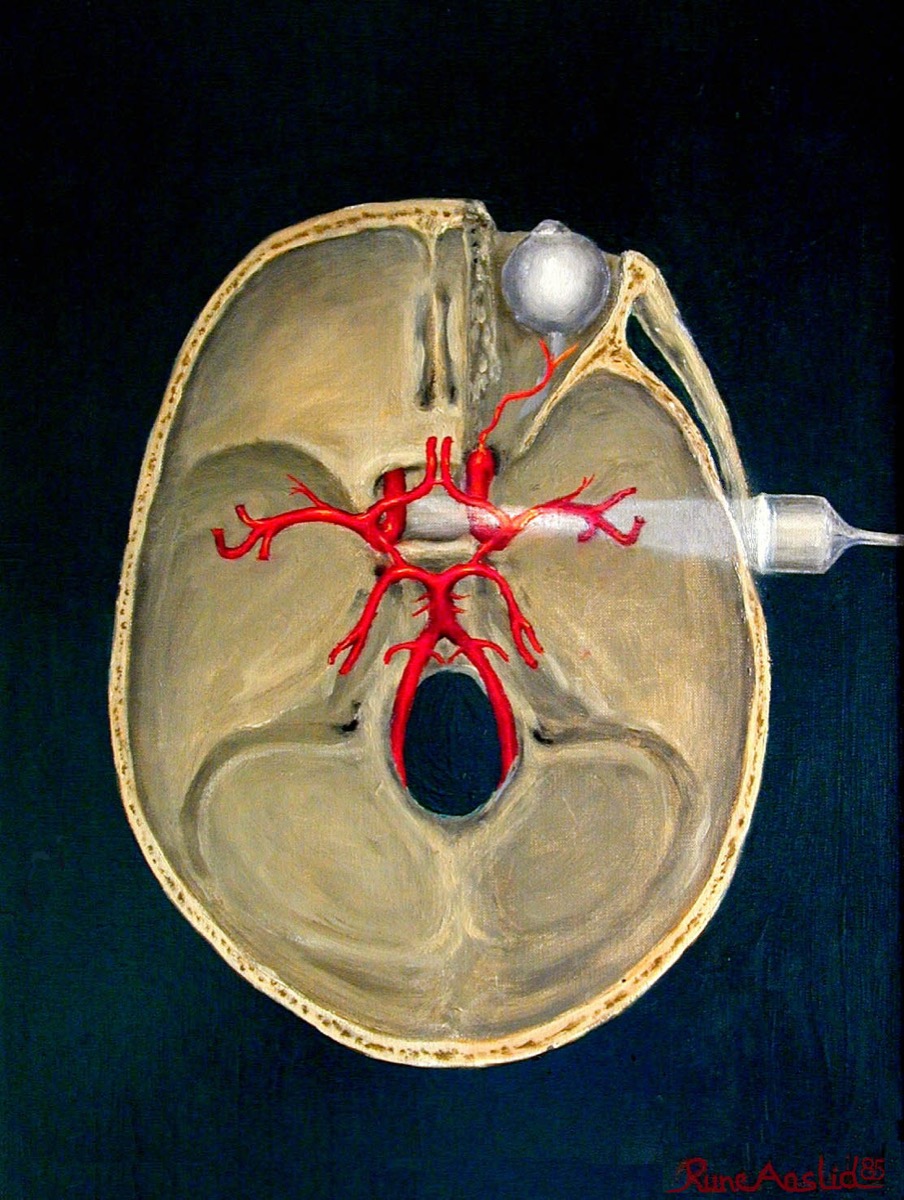 Transcranial Doppler ultrasound, which sends ultrasound waves through the skull near the temple to measure blood flow in the arteries at the base of the brain (Rune Aaslid, CC BY 3.0)
On the other hand, if warning signs appear that differ from the usual tightness, you should be tested right away. If a headache starts suddenly without warning and reaches its worst within a few minutes, go to the emergency room without delay. If the headache comes with weakness in one arm or leg or slurred speech, if a headache is severe enough to wake you from sleep, or if the pattern of your headaches has clearly changed from before or dizziness comes with it, do not put off a visit, and have the cause checked.
How Does Extracorporeal Shockwave Therapy Loosen the Stiff Back of the Neck and Shoulders?
If an examination confirms tension-type headache together with knotted neck and shoulder muscles, we apply extracorporeal shockwave therapy to the fascia at the back of the neck and in the shoulders that has stiffened from tension. Extracorporeal shockwave therapy is a treatment that sends short, strong pulses into stiff muscles and fascia from outside the skin, without putting a needle into the body.
Depending on the location and depth of the lesion, we use two Swiss STORZ MEDICAL shockwave devices for different jobs. The radial type spreads the shockwave widely and is applied to areas that have stiffened over a broad surface, such as the fascia at the back of the neck and in the shoulders, while the focused type gathers the energy into one point and is applied to deep, narrow lesion sites. The procedure takes about 5 minutes, needs no hospital stay, and you go back to daily life on the same day. During treatment you feel a dull pressing sensation at the knotted spot, and for a few days afterward the treated area may sting or look bruised. If you regularly take anticoagulants, let us know before the procedure.
A meta-analysis that pooled 11 randomized controlled trials in patients with myofascial pain syndrome of the neck and shoulder found that, compared with other treatments, extracorporeal shockwave therapy improved pain intensity and the ability to tolerate pressing force (pressure pain threshold) right after treatment, while neck disability scores showed no significant difference between treatment groups (Jun JH et al., 2021). In a clinical trial that randomly divided 50 patients with cervicogenic headache, the group that received 4 weeks of standard physical therapy plus extracorporeal shockwave therapy to trigger points in the upper shoulder muscle (upper trapezius) improved clearly more in both pain score and headache disability index after 4 weeks than the group that received standard physical therapy plus sham shockwave (Hammam RF et al., 2024).
If the neck and shoulder muscles stay knotted over a wide area and needle treatment feels like too much of a burden, we use Winback TECAR therapy, a radiofrequency treatment, to warm the deep tissue layers and loosen stiff muscles and fascia. Depending on the patient's condition, shockwave and radiofrequency treatment are sometimes given together. On the other hand, if examination and testing identify cervicogenic headache or occipital neuralgia, we perform a nerve block, an injection at the nerve site that causes the pain, while watching the needle position on a C-arm or ultrasound.
When headaches are not well controlled by medication and keep recurring chronically, we perform transcranial magnetic stimulation (TMS). While the patient lies comfortably in a recliner, TMS sends a magnetic field from outside the head to stimulate a specific area of the brain noninvasively. Alongside these treatments at the clinic, in daily life it helps to fix your work setup, such as monitor height and sitting posture, exercise regularly, and get enough sleep. The goal of treatment is to loosen the stiff back of the neck and shoulders and cut down the days you reach into the drawer for a painkiller.
Sung-Woog Lee · Medical Director · Board-Certified Neurologist · Guri Top Bone Clinic
Related Articles
- Cervicogenic Headache: Diagnostic Criteria and Nerve Block
- What Starts a Migraine: Causes and Triggers
- Tension-Type Headache Medical Information (Linkare Knowledge)
References
- Ashina S, Mitsikostas DD, Lee MJ, Yamani N, Wang SJ, Messina R (2021). Tension-type headache.. Nat Rev Dis Primers. PMID: 33767185
- Ashina S, Bendtsen L, Lyngberg AC, Lipton RB, Hajiyeva N, Jensen R (2015). Prevalence of neck pain in migraine and tension-type headache: a population study.. Cephalalgia. PMID: 24853166
- Fernández-de-Las-Peñas C, Ge HY, Arendt-Nielsen L, Cuadrado ML, Pareja JA (2007). Referred pain from trapezius muscle trigger points shares similar characteristics with chronic tension type headache.. Eur J Pain. PMID: 16919982
- Diener HC, Dodick D, Evers S, Holle D, Jensen RH, Lipton RB (2019). Pathophysiology, prevention, and treatment of medication overuse headache.. Lancet Neurol. PMID: 31174999
- Jun JH, Park GY, Chae CS, Suh DC (2021). The Effect of Extracorporeal Shock Wave Therapy on Pain Intensity and Neck Disability for Patients With Myofascial Pain Syndrome in the Neck and Shoulder: A Meta-Analysis of Randomized Controlled Trials.. Am J Phys Med Rehabil. PMID: 32520797
- Hammam RF, Alshimy AM, Elabd OM, Elabd AM (2024). Effect of Extracorporeal Shock Wave on Upper Trapezius Trigger Points in Patients With Cervicogenic Headache: A Randomized Clinical Trial.. Am J Phys Med Rehabil. PMID: 38630838
Frequently Asked Questions
Q. Can a tension-type headache also last for several days once it starts?
A tension-type headache that comes on occasionally can last anywhere from 30 minutes to 7 days once it starts. If it lasts longer than usual or the character of the pain has changed, record when it started and any accompanying symptoms, and have a doctor determine whether another cause is involved.
Q. Can tension-type headache and migraine occur together in one person?
Two kinds of headache can occur in one person on different days. If you record in a diary, each time a headache comes, the character of the pain, whether it gets worse with movement, whether there is nausea, and the medication you took, it helps in deciding the treatment that fits each headache.
Q. If I take painkillers on more than ten days a month, does that count as medication-overuse headache?
For the diagnosis, doctors check whether headaches occur on 15 or more days a month and whether use above the overuse threshold for each drug has continued for more than 3 months. The overuse threshold is 15 or more days a month for simple painkillers, and 10 or more days a month for combination painkillers or triptans. Even before the threshold is reached, if the days of use are increasing, record the drug names and the dates you took them, and adjust your medication plan with your doctor.