
Last updated: 2026-11-18
My Shoulder Catches Every Time I Wash My Hair and My Arm Won't Go Up
For months, a woman in her 50s has felt her shoulder catch partway every time she lifts her arm to wash her hair. We put this scene together from situations commonly experienced in daily life, to help you understand. Every morning she has trouble getting her arm into the sleeve of her top, and she cannot reach behind her back to fasten her bra hook. When she rolls onto the painful side in her sleep at night, her shoulder throbs and sometimes wakes her.
If you have had trouble washing your hair and getting dressed for months because your arm won't go overhead, rather than vaguely waiting for your frozen shoulder to loosen up with time alone, you should consider treatment that directly releases the stiffened joint capsule with ultrasound-guided injection and hydrodilatation. People around you often say it loosens up as the years go by. In fact, many people do get better over time. But not every patient recovers fully on their own, and in some, pain and limited movement remain for more than two years.
At Guri Top Bone Clinic, we treat the stiffened joint capsule with ultrasound-guided injection. We perform hydrodilatation, which puts medication into the shoulder joint to inflate and stretch the hardened capsule from the inside.
Why Does the Shoulder Joint Capsule Thicken and Stiffen?
This condition is commonly called frozen shoulder, but its formal medical name is adhesive capsulitis. The shoulder joint is where the head of the upper arm bone meets the shoulder blade. The joint capsule wraps around this joint like a soft pouch. When this capsule becomes inflamed and fibrosis, in which the tissue turns stiff, follows, the capsule that originally had room to spare thickens and the joint stiffens (Lee BC et al., 2025).
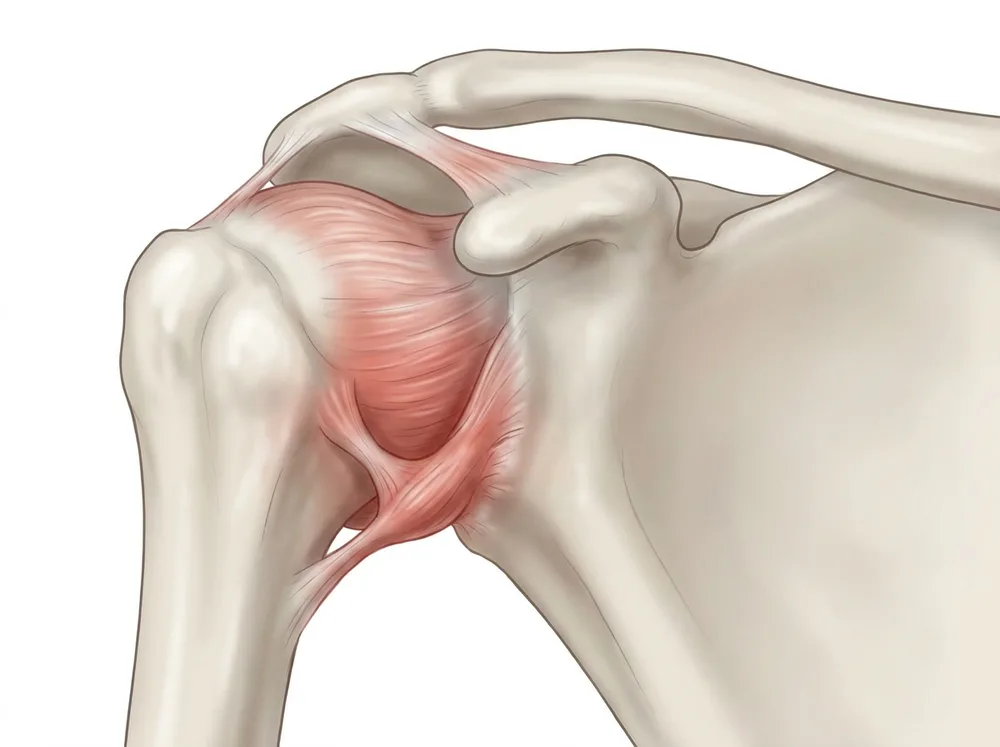 Thickened, stiffened shoulder joint capsule (shown in red) · AI-generated educational illustration
When the pouch that surrounds the shoulder joint itself shrinks and stiffens, movement decreases in every direction, including raising the arm forward or to the side, rotating it outward, and turning it behind the back. Unlike when only a tendon is injured, the joint pouch is physically blocked. That is why, even when the patient relaxes and someone else takes hold of the arm and lifts it, it catches and stops at exactly the same height.
Frozen shoulder mainly occurs between the ages of 40 and 65 and is more common in women than in men. Metabolic conditions such as diabetes, thyroid disease, and dyslipidemia also raise the risk of developing it (Lee BC et al., 2025). According to a study of 3.47 million adults aged 20 and older who had undergone National Health Insurance Service health checkups, tracked through the end of 2018, the risk of developing frozen shoulder, compared with people with normal blood sugar, was 1.08 times as high in those with prediabetes, 1.31 times as high in those with newly diagnosed type 2 diabetes, and 1.47 times as high in patients with type 2 diabetes already taking diabetes medication (Kim JH et al., 2023). Abnormal blood sugar metabolism affects inflammation and fibrosis of the joint capsule.
How Far Is It True That Everything Loosens Up with Time?
Frozen shoulder generally goes through three stages: a period when the pain gets worse, a period when the joint stiffens, and a period when it gradually loosens again. These three periods sometimes come in order, but they also sometimes overlap. According to a Korean clinical practice guideline for frozen shoulder published in 2025, it generally gets better over time. However, the guideline concludes that not every patient recovers fully on their own and that in some patients symptoms remain for more than two years (Lee BC et al., 2025).
One study followed 223 patients (269 shoulders) for an average of 4.4 years from the onset of symptoms. In it, 59% of the total returned to a normal or near-normal shoulder, but the remaining 41% still had symptoms years later (Hand C et al., 2008). Even when symptoms remained, in 94% they were mild enough to allow daily life, with pain the most common among them, but 6% of the total were left with severe pain and severely reduced arm function (Hand C et al., 2008). In particular, those whose symptoms were most severe at onset also had the worst shoulder condition years later (Hand C et al., 2008).
A similar tendency is also seen in a systematic review that pooled seven studies, each of which followed untreated patients for more than six months. When they were watched without treatment, shoulder movement improved to some extent over one to four years but did not fully return to its original state (Wong CK et al., 2017). The same review also shows that shoulder movement recovered by a larger margin early in the course of symptoms than after a long time had passed (Wong CK et al., 2017). Over the months to years that frozen shoulder takes to run its course, many patients experience severe pain that disrupts sleep, along with reduced arm function. For this reason, treatment that loosens the stiffened joint capsule early on to reduce pain and widen the range of motion is important.
When It's Confused with Calcific Tendinitis or Rotator Cuff Disease
Diagnosing frozen shoulder centers on listening to the patient's history and examining the shoulder by moving it directly (Lee BC et al., 2025). Two things are measured together: the angle at which the patient can raise the arm on their own, and the range of motion when the examiner takes hold of the relaxed arm and lifts it. If the angle to which the arm goes up is similarly limited in both cases, frozen shoulder, in which the joint capsule has stiffened, is suspected first. When symptoms are not typical, or when the condition needs to be distinguished from other shoulder problems, ultrasound and MRI are used as supplementary tests that support the physical examination (Lee BC et al., 2025).
Besides frozen shoulder, the causes that keep the arm from going overhead include calcific tendinitis, rotator cuff disease, and acromioclavicular joint disease, and their outward symptoms overlap with one another. At Guri Top Bone Clinic, we directly move the patient's shoulder tendons while viewing them with musculoskeletal ultrasound and check on the screen in real time for rotator cuff tears, calcium deposits within the tendon, or inflammation of the bursa.
Because the direction of treatment is the exact opposite depending on the condition, the cause must be pinpointed accurately in this way. When the joint capsule has stiffened, it needs to be actively stretched and loosened, but when a rotator cuff tendon is torn or damaged, you should not force movement and should wait for it to recover. If your arm suddenly has no strength after a fall or a blow to the shoulder, the tendon may have been damaged. You should therefore be examined without delay. In addition, when shoulder pain comes together with tingling that runs down from the arm to the fingertips, at Guri Top Bone Clinic we also use electromyography and nerve conduction studies to check whether that tingling comes from a nerve in the neck.
How Do Hydrodilatation Injections Stretch a Stiffened Joint Capsule?
We treat a stiffened joint capsule with ultrasound-guided injection. When giving the joint injection, we watch the needle and the shoulder joint together with musculoskeletal ultrasound, confirm that the needle tip has precisely entered the narrowed joint space (joint cavity), and then inject the medication. The hydrodilatation performed at this point is a treatment that puts a sufficient amount of medication into the joint to inflate the shrunken, stiffened capsule from the inside with hydraulic pressure and stretch it. Because ultrasound-guided injection does not use radiation, there is no concern about radiation exposure even if the procedure is performed several times depending on your progress.
In a meta-analysis that pooled 65 randomized trials (4,097 patients) comparing treatments for frozen shoulder, intra-articular steroid injection was the only treatment that clearly improved pain and shoulder function more than other conservative treatments within 12 weeks after treatment (Challoumas D et al., 2020). In the same analysis, using intra-articular injection early, when less than 1 year had passed since symptoms began, produced better results, and adding simple exercises and stretching at home produced a greater treatment effect up to 12 months (Challoumas D et al., 2020).
The Korean clinical practice guideline likewise recommends intra-articular steroid injection, and it also recommends adding hydrodilatation to it for relieving shoulder pain and restoring arm function (Lee BC et al., 2025). In the studies pooled by the guideline, the group that received hydrodilatation in addition to steroid injection had a greater reduction in pain at 2 to 6 weeks and at 8 to 16 weeks after the procedure than the group that received intra-articular steroid injection alone (Lee BC et al., 2025). In a systematic review of hydrodilatation studies as well, hydrodilatation improved shoulder disability and the range of outward rotation of the arm more than steroid injection alone for a while after treatment (Poku D et al., 2023).
If you have diabetes, you should let us know before the procedure, because your blood sugar may rise temporarily after the injection. After hydrodilatation inflates the inside of the joint, the injection site may feel achy or swell for about a day. To prevent infection, also avoid baths and saunas on the day of the procedure.
When not only the joint capsule but also the tissues around the shoulder have stiffened, or when pain overlaps, we add treatment matched to your condition. When the joint stiffens and the arm cannot be used for a long time, the muscles and fascia around the shoulder become stiff, and in this case we use Winback TECAR therapy, a radiofrequency treatment. Winback warms the deep layers of tissue to softly loosen the stiffened muscles and fascia, and because the joint can be moved with the electrode handpiece resting on the shoulder, it helps restore the range of motion. On the day of an injection, however, we avoid the injection site. If ultrasound examination shows overlapping calcific tendinitis or rotator cuff tendinitis and pain remains around the shoulder, we perform extracorporeal shockwave therapy. Extracorporeal shockwave therapy takes about 5 minutes per session, and you usually receive it 2 to 3 times at 1-week intervals.
After injection treatment has calmed the pain and made room in the joint capsule, you steadily continue simple exercises and stretching at home. The goal of all these treatments is to regain a daily life in which your arm goes smoothly overhead without catching partway when you wash your hair and put on a top in the morning, and in which you sleep comfortably at night without shoulder pain waking you.
Sung-Woog Lee · Medical Director · Board-Certified Neurologist · Guri Top Bone Clinic
Related Articles
- When Your Arm Won't Go Up: Differentiating Calcific Tendinitis and Rotator Cuff Disease
- Rotator Cuff Tear: Is Arm Weakness Coming From the Tendon or a Nerve?
- Calcific Tendinitis Treatment: How Shockwave Therapy and Injections Are Divided by Phase
- Adhesive Capsulitis Medical Information (Linkare Knowledge)
References
- Lee BC, Kim BS, Lee BJ, Moon CW, Park CH, Han JY (2025). Clinical Practice Guidelines for Diagnosis and Non-Surgical Treatment of Primary Frozen Shoulder.. Ann Rehabil Med. PMID: 40602400
- Kim JH, Kim BS, Han KD, Kwon HS (2023). The Risk of Shoulder Adhesive Capsulitis in Individuals with Prediabetes and Type 2 Diabetes Mellitus: A Longitudinal Nationwide Population-Based Study.. Diabetes Metab J. PMID: 37915186
- Hand C, Clipsham K, Rees JL, Carr AJ (2008). Long-term outcome of frozen shoulder.. J Shoulder Elbow Surg. PMID: 17993282
- Wong CK, Levine WN, Deo K, Kesting RS, Mercer EA, Schram GA, Strang BL (2017). Natural history of frozen shoulder: fact or fiction? A systematic review.. Physiotherapy. PMID: 27641499
- Challoumas D, Biddle M, McLean M, Millar NL (2020). Comparison of Treatments for Frozen Shoulder: A Systematic Review and Meta-analysis.. JAMA Netw Open. PMID: 33326025
- Poku D, Hassan R, Migliorini F, Maffulli N (2023). Efficacy of hydrodilatation in frozen shoulder: a systematic review and meta-analysis.. Br Med Bull. PMID: 37496207
Frequently Asked Questions
Q. Can frozen shoulder develop even after your 50s?
Although its Korean name literally means "fifty-year-old shoulder," it can also develop in your 60s and later. The cause is not decided by age alone; we check when the shoulder pain began and how movement is limited, to distinguish it from arthritis, tendon disorders, and other conditions.
Q. If I have diabetes, what should I report before a joint injection for frozen shoulder?
You should report your recent blood sugar and HbA1c levels, any diabetes medication or insulin you are taking, and any past experience of your blood sugar rising after an injection.
Q. When do I start practicing raising my arm overhead after hydrodilatation?
After the procedure, we check your pain and the range of motion of your shoulder to decide when to start exercising and how far to go. Even if your arm can go up farther, rather than pushing it all the way up right away, you repeat practicing movement within the range you were guided to and carry it on into daily movements such as washing your hair.
Q. How should I set the intensity of stretching at home after injection treatment?
Move slowly to the point of a gentle pull, and if sharp pain occurs, reduce the force and the range of motion. If pain lingers for a long time after exercise or gets worse that night, reduce the intensity and duration of the next session, and report persistent pain at your follow-up visit so that the exercise range can be adjusted.