
Last updated: 2026-09-18
Does Arm Weakness Mean the Rotator Cuff Is Torn?
People who feel their arm give out when lifting it and who wake at night with shoulder pain struggle both with daytime arm use and nighttime sleep. When even placing a light bowl on a high shelf makes the elbow suddenly drop, or lying on the sore shoulder brings on spreading pain, every daily movement starts to feel risky. Facing this weakness, many people first worry that a shoulder tendon has torn badly.
 Illustration of the four rotator cuff muscles (supraspinatus, infraspinatus, teres minor, and subscapularis) viewed from front and back. Useful for seeing which muscle corresponds to a weak movement. (InjuryMap, CC BY-SA 4.0)
The rotator cuff is a group of four muscles and tendons that wrap around the shoulder joint and let the arm lift and rotate steadily. Made up of the supraspinatus, infraspinatus, teres minor, and subscapularis, this group holds the head of the upper arm bone (humerus) firmly against the shoulder socket (glenoid). A rotator cuff tear occurs when part of the thickness of one of these tendons is damaged, or when the full thickness of the tendon splits open. This combined inflammation and structural loss that can cause significant pain and loss of function.(Bedi Asheesh et al., 2024) A sudden feeling of the arm "giving out" when lifting naturally points first toward tendon damage. In clinical practice, though, some patients also have a coexisting nerve problem around the shoulder in addition to the tendon issue. For this reason, doctors work through the exam step by step to identify exactly which structure is causing the weakness.
How Do a Torn Tendon and a Pinched Nerve Look Different on Exam?
When a patient reports that the shoulder "has no strength," the exam distinguishes between a momentary inability to generate force because of pain and a true loss of strength caused by a nerve or muscle problem itself. The clinician asks in detail about when the injury occurred, whether the patient has repeatedly raised the arm overhead for work or sports, and which angles or movements bring on the pain. The exam then compares abduction strength (lifting the arm to the side) and external rotation strength (rotating the forearm outward with the elbow tucked in) against the unaffected side, along with pain-provocation tests.(Bedi Asheesh et al., 2024)
A typical pattern with a rotator cuff tear is sharp pain at a specific angle of lifting the arm, with a dull ache spreading toward the outer deltoid area of the arm. Pain that is worse at night and disrupts sleep is also common. Tingling or numbness reaching the fingertips is not a symptom of rotator cuff damage; it points toward a nerve issue instead.
One notable nerve cause of shoulder weakness is suprascapular neuropathy. The suprascapular nerve starts at the neck, passes through a notch in the shoulder blade (scapula), and carries motor and sensory signals to the supraspinatus and infraspinatus muscles. When this nerve is compressed or injured, patients often feel a deep, heavy ache in the back of the shoulder, and the muscle behind the shoulder blade can visibly thin and appear sunken. External rotation strength, in particular, drops noticeably. Depending on whether the compression occurs at the upper notch of the scapula (suprascapular notch) or further down (spinoglenoid notch), either both the supraspinatus and infraspinatus can weaken, or only the infraspinatus may be affected.(Boykin Robert E et al., 2010)
Suprascapular nerve injury can result from repeated large overhead motions in sports such as volleyball or swimming, compression by a labral cyst near the narrow tunnel the nerve passes through, or abnormal nerve stretching caused by a large rotator cuff tear. On the other hand, if tilting the head back or turning it toward the painful side sends a shooting pain down the entire arm, a cervical disc (spinal disc) problem affecting a neck nerve root should be suspected. Rarely, a case of severe pain lasting several days followed suddenly by clear paralysis and muscle wasting may indicate neuralgic amyotrophy, which should also be considered. A study analyzing needle electromyography in patients who underwent rotator cuff surgery found cases where a tendon tear and neuropathy were present together.(Ochiai Nobuyasu et al., 2026) The two problems can occur in the same shoulder at the same time.
What Do Ultrasound and EMG Each Show?
Confirming both the shape of tendon damage and whether nerve function is intact objectively requires a combination of tests. Musculoskeletal ultrasound is a key diagnostic tool that involves placing a probe on the surface of the shoulder to view the tendon's defect and continuity in real time. Because the exam can be done while moving the arm in and out, it can capture dynamic impingement (the tendon striking bone during movement) and can also detect calcium deposits within the tendon or inflammation of the bursa (a fluid-filled sac) surrounding it. Ultrasound is useful for identifying full-thickness tears where the tendon is completely severed. For partial tears, the accuracy of detection can vary depending on the tear's location and the examiner's experience.(Smith T O et al., 2011)
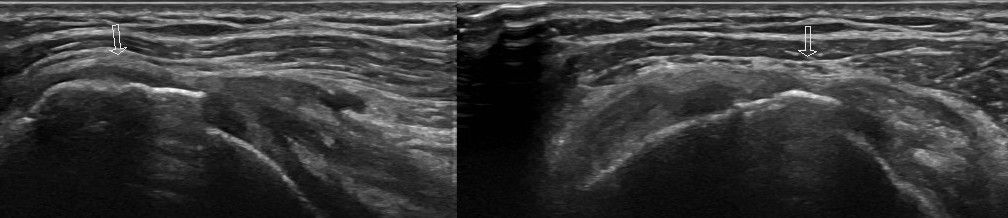 Ultrasound image of a full-thickness rotator cuff tear (arrow marks where the tendon is torn). This is public educational material, not an image from a patient at this clinic. (Mme Mim, CC BY-SA 3.0)
While ultrasound shows the outer structure of the tendon, electromyography (EMG) and nerve conduction studies directly measure the electrical signals traveling through nerves and the response of muscle fibers. A nerve conduction study applies a mild electrical stimulus to a peripheral nerve and records the speed of transmission and the size of the resulting waveform. Needle EMG inserts a thin needle into the muscle to read the small electrical activity that appears both at rest and during contraction. These tests can reveal whether the axons (nerve fibers) of the suprascapular nerve are damaged, detect abnormal denervation potentials, and identify polyphasic motor unit potentials that appear during the recovery phase after nerve injury, which helps distinguish whether the problem lies in a shoulder nerve itself or in a neck nerve root.(Boykin Robert E et al., 2010)
Right after a nerve injury, though, denervation findings on needle EMG do not show up immediately (it typically takes several weeks), so the timing of the test and the choice of target muscles need to be planned carefully. At Guri Top Bone Clinic, a neurologist personally performs the EMG to track the suspected site of nerve injury and compares the results against prior records to follow the trend in nerve function over time. If tendon retraction is severe, or if the exact location of a nerve-compressing cyst, a labral injury, or fatty degeneration of the muscle needs to be viewed from multiple angles, the case is referred to a partner institution for detailed imaging.
How Are Partial Tears Treated?
If detailed testing confirms only a partial tear (where just part of the tendon thickness is torn) or tendinopathy (weakened tendon tissue), treatment centers on exercise therapy: gradually strengthening the muscles around the shoulder and restoring the joint's normal range of motion, within limits the patient can tolerate.(Desmeules François et al., 2025) Pain-relieving treatments serve as a stepping stone, helping the patient complete a planned rehabilitation program without pain standing in the way.
Several non-surgical treatments are applied in stages, matched to the patient's pain level and degree of inflammation. Ultrasound-guided injection delivers medication precisely into the subacromial bursa or the space around the tendon where inflammation is severe, using real-time ultrasound imaging to relieve pain. Once pain has eased somewhat, extracorporeal shock wave therapy may be considered. This is a physical stimulation treatment that sends sound wave energy to the affected area to support microcirculation and suppress substances involved in pain transmission. Shock wave therapy is notably useful for lesions that also involve calcium deposits, and is typically carried out at roughly weekly intervals while monitoring progress.
To address chronic pain around the tendon and a loosened joint environment, regenerative injection treatments using concentrated dextrose, PDRN, placental extract, or the patient's own blood (autologous blood) may also be selected; these are treatments intended to promote a local tissue healing response. In addition, if the area around the joint has stiffened and movement is limited, deep-heat radiofrequency treatment (Winback) to relax tissue tension can be combined with manual therapy to gently expand the range of motion, improving the efficiency of rehabilitation.
If ultrasound or EMG findings also show suprascapular nerve entrapment, nerve-directed measures are needed alongside tendon treatment. This includes limiting excessive overhead arm movements and performing a nerve block to reduce swelling and pain signaling around the nerve.(PMID 22508253) A nerve block is a treatment for controlling severe nerve-related pain. Reduced pain does not mean the cause of nerve compression has resolved or that strength has fully returned, so strength should continue to be checked. If a large cyst pressing firmly on the nerve is found, or if pain-control injections are repeated at short intervals, side effects such as tissue weakening can occur, so a safe interval between treatments should be maintained.
What Does a Full-Thickness Tear Mean?
Hearing the diagnosis of a "full-thickness tear" can feel discouraging, as if all the tendons in the shoulder have snapped and the arm can no longer be used at all. In fact, a full-thickness tear simply means a hole or defect has formed that goes through the entire thickness of one tendon. It does not mean all four tendons supporting the shoulder are gone. Actual arm-lifting function varies a great deal from patient to patient, depending on how wide the tear is, where it is located, and how much the remaining surrounding muscles are compensating for the lost function.
Many patients with a degenerative full-thickness tear that developed gradually without a specific injury still have relatively good ability to lift the arm and can carry out daily activities without much difficulty. In these cases, even though the tendon defect will not close on its own, continuing non-surgical treatment (shoulder-stabilizing exercises and pain management) can be enough to maintain daily function.(Bedi Asheesh et al., 2024)(Edwards Peter et al., 2016) On the other hand, if a patient develops pseudoparalysis (a complete inability to lift the arm above 90 degrees) right after a fall or strong impact, or if shoulder strength keeps visibly declining and muscle wasting worsens over repeated visits, it becomes important to discuss the risks and benefits of surgical repair rather than persisting with non-surgical treatment alone.
In severe cases with a very wide tear and an inability to lift the arm, checking whether a traction injury to the suprascapular nerve is present alongside the tendon tear is an important factor in shaping the treatment plan going forward.(Ochiai Nobuyasu et al., 2026) Severe weakness seen with a massive tear may be the combined result of both the tendon defect and nerve dysfunction. Even while continuing non-surgical management, patients should not rely solely on the feeling that pain has eased; regular follow-up exams should check whether abduction strength (lifting the arm) and external rotation function are being preserved. If strength keeps declining or function keeps worsening during conservative management, referral to a higher-level medical institution at the right time is essential so the window for further treatment is not missed.
Lee Seong-uk · Medical Director · Board-certified Neurologist · Guri Top Bone Clinic
References
- Bedi Asheesh, Bishop Julie, Keener Jay (2024). Rotator cuff tears.. Nat Rev Dis Primers. PMID: 38332156
- Boykin Robert E, Friedman Darren J, Higgins Laurence D, Warner Jon J P (2010). Suprascapular neuropathy.. The Journal of bone and joint surgery. American volume. PMID: 20926731
- Ochiai Nobuyasu, Hashimoto Eiko, Ohtori Seiji, Takahashi Norimasa, Matsuki Keisuke, Sugaya Hiroyuki (2026). Prevalence of rotator cuff tear concomitant with neuropathy: analysis of 659 cases using needle electromyography.. JSES reviews, reports, and techniques. PMID: 42254063
- Smith T O, Back T, Toms A P, Hing C B (2011). Diagnostic accuracy of ultrasound for rotator cuff tears in adults: a systematic review and meta-analysis.. Clinical radiology. PMID: 21737069
- Desmeules François, Roy Jean-Sébastien, Lafrance Simon (2025). Rotator Cuff Tendinopathy Diagnosis, Nonsurgical Medical Care, and Rehabilitation: A Clinical Practice Guideline.. J Orthop Sports Phys Ther. PMID: 40165544
- Treatment of suprascapular neuropathy varies depending on the cause of compression. PMID: 22508253
- Edwards Peter, Ebert Jay, Joss Brendan, Bhabra Gev, Ackland Tim, Wang Allan (2016). EXERCISE REHABILITATION IN THE NON-OPERATIVE MANAGEMENT OF ROTATOR CUFF TEARS: A REVIEW OF THE LITERATURE.. International journal of sports physical therapy. PMID: 27104061
FAQ
Q. Can there be a problem with the suprascapular nerve even without hand numbness?
Yes. The suprascapular nerve does not carry sensation from the skin of the hand, so a problem with this nerve can occur without any hand numbness. A nerve problem should not be ruled out based on numbness alone; the exam should also check for shoulder weakness and muscle wasting. Related evidence
Q. Does everyone with a confirmed rotator cuff tear need an EMG?
No. A confirmed tear alone does not mean every patient needs an EMG. When weakness or muscle wasting cannot be fully explained by the tendon damage alone, EMG and nerve conduction studies are considered to help distinguish a nerve problem. Related evidence
Q. If ultrasound already shows a tear, is an MRI referral ever still needed?
Yes, in some cases. If additional causes need to be identified, such as the extent of muscle wasting or a cyst pressing on a nerve, an MRI may be ordered. Even after ultrasound has found a tear, further testing may be needed if it does not fully explain the weakness. Related evidence
Q. If pain improves after an injection, does that mean the tendon or nerve has recovered?
Not necessarily. Reduced pain alone does not indicate that the tendon has healed or that nerve function has recovered. Weakness can remain even when pain is milder, so exercise intensity should be adjusted based on the care team's measurements of strength and range of motion.