
Last updated: 2026-11-05
It Knots Up Again After Massage, and Pressing Spreads Pain Elsewhere
If a tight spot knots up again even after massage and pressing on it hurts somewhere else too, you're dealing with two kinds of pain at once: local pain at the tight spot and pain that radiates to a distant area. In myofascial pain syndrome, trigger points inside the muscle produce both of these. A typical case is a 40-something office worker whose shoulder feels much looser on the day of a massage, but a few days later, pressing the same spot sends pain up into the back of the neck and the back of the head.
Myofascial pain syndrome is a condition in which trigger points form within taut bands inside a muscle, causing both local pain at that spot and referred pain that spreads to a distant area. A trigger point here is a hypersensitive spot that develops in a subset of the muscle fibers making up the muscle (Barbero Marco et al., 2019). Simple muscle tightness—the kind of temporary stiffness that comes from using a muscle heavily in everyday activity—usually hurts only at the tight spot and tends to settle within a few days of rest. Pressing on a trigger point in myofascial pain syndrome, by contrast, reproduces the exact pain the patient is already familiar with and makes it spread to other areas.
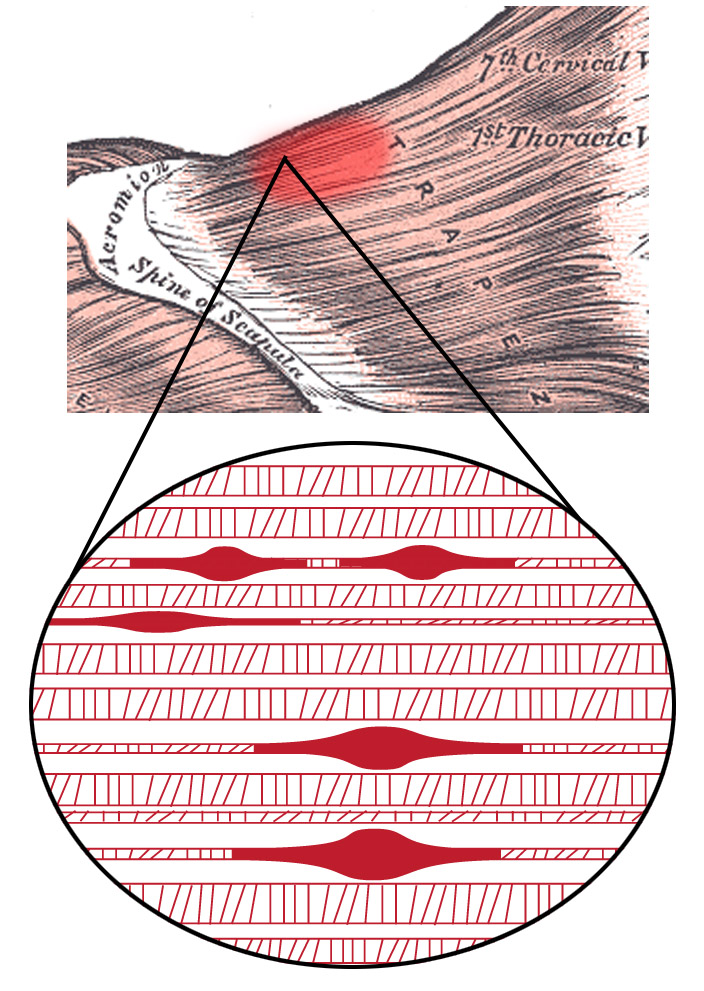 A trigger point in the upper trapezius muscle, with a close-up of the muscle fibers showing some fibers thickened in a spindle shape (Davidparmenter, CC BY-SA 3.0)
Muscle overuse, postural imbalance, systemic conditions, and psychological and behavioral factors all play a combined role in how trigger points form and persist (Steen Jeremy P et al., 2025). Trigger points commonly appear in the neck, upper shoulder, the area along the inner shoulder blade, the lower back, and the buttock muscles—regions that carry heavy repetitive load and postural strain, such as during computer work or housework. When pain makes someone move less than usual, the muscle stays tense as a result. So even when massage loosens the muscle temporarily, the same spot tightens back up if the strain-inducing posture and repetitive activity continue.
How Is This Different from Simple Muscle Knots, Disc Problems, or Nerve Problems?
A consensus study involving 60 experts from 12 countries identified a taut band within the muscle, a hypersensitive spot within that band, and referred pain elicited by pressure as the core diagnostic criteria for a trigger point (Fernández-de-Las-Peñas César et al., 2018). Eighty percent of the experts in this study reported that referred pain appears not only as pain spreading to a distant site but also as deep, dull pain, tingling, or burning. Referred pain varies in location and sensation from patient to patient and from muscle to muscle where the trigger point is located.
Myofascial pain syndrome can cause tingling or radiating symptoms, so it easily overlaps with fibromyalgia, neuropathic pain, and joint disorders (Steen Jeremy P et al., 2025). For example, when a cervical disc (the cartilage between the vertebrae) compresses a nerve, neck pain can appear along with tingling that travels down the arm to the fingertips and weakness in the hand, and when a lumbar disc (the cartilage between the vertebrae) presses on a nerve, tingling can travel down from the buttock into the leg.
To determine whether a nerve is being compressed, clinicians examine the distribution of the tingling together with whether actual sensory loss or muscle weakness is present. Myofascial pain syndrome and radiculopathy can occur together in the same patient, so both problems need to be evaluated together. If pain starting from trigger points in the upper trapezius, levator scapulae, or suboccipital muscles radiates to the back of the head, it needs to be distinguished from cervicogenic headache, which arises from problems with the cervical nerves or joints. Also, if pain at the top of the shoulder and along the inner border of the shoulder blade persists, the possibility of shoulder conditions other than frozen shoulder should be kept in mind.
If This Pain Doesn't Show Up on a Scan, Why Order Tests?
Diagnosing myofascial pain syndrome relies mainly on taking the patient's symptom history and on a physical exam in which the physician presses directly on the muscle by hand to identify taut bands and trigger points (Barbero Marco et al., 2019). Trigger points themselves do not show up on a standard scan, but depending on the patient's symptoms, imaging and blood tests can help identify and rule out other causes of similar pain, such as nerve compression, inflammatory disease, infection, or tumors (Steen Jeremy P et al., 2025).
When numbness or radiating pain accompanies the condition and a nerve problem is suspected, a neurologist directly performs electromyography (EMG) and nerve conduction studies to locate where the nerve is being compressed. Nerve conduction studies apply a weak electrical stimulus to a peripheral nerve and measure the speed and amplitude of the resulting signal, while EMG measures the electrical activity of the muscle to assess whether the nerve or muscle is abnormal. Checking the distribution of the electrical responses seen on these tests helps determine where nerve damage or compression is likely. Comparing the structural findings on MRI with the functional findings from EMG and nerve conduction studies also helps distinguish the actual nerve abnormality causing the patient's current symptoms.
Musculoskeletal ultrasound is also used to check the condition of the muscle and surrounding soft tissue. X-rays are mainly used to assess the alignment of bones and joints. Musculoskeletal ultrasound, by contrast, allows real-time observation of tendons, ligaments, muscles, and bursae without radiation exposure. Muscle pain can occur alongside — or be mistaken for — tendon tears, fluid buildup in a bursa, or calcium deposits, and ultrasound lets the physician directly check these detailed tissue changes.
Why Treatment Differs Between a Sudden Muscle Strain and Long-Hardened Fascia
The treatment approach for fascia and muscle pain differs depending on when the symptoms started and how stiff the tissue has become. For acute pain or areas where the muscle or fascia has tightened—such as sudden difficulty turning the neck after waking up in the morning, or a strained lower back muscle from lifting something—spray and stretch therapy is used. In this treatment, a cold spray is applied along the direction of the muscle fibers while the muscle is held in a comfortably stretched position, followed by muscle relaxation combined with stretching. A literature review of related randomized studies found that they mainly assessed the short-term effects of combining spray with stretching, mostly in the upper trapezius muscle (Jung Chul Hee et al., 2026).
If a distinct tender point can be felt within the muscle and pain makes it hard to move the neck or shoulder, ultrasound-guided injection is used. With ultrasound guidance, the needle and target tissue are visible in real time. This lets the doctor watch the needle's position directly on the ultrasound image and inject the medication along the hardened fascial layer while avoiding nearby blood vessels and nerves. A clinical study of 41 patients with trapezius myofascial pain syndrome compared, by injection guidance method, the changes in pain scores and neck function after 4 weeks (Kang Jung Joong et al., 2019).
Extracorporeal shockwave therapy is used for long-standing fascial pain in the neck, shoulders, and back. Guri Top Bone Clinic applies either the radial or the focused type depending on how deep the lesion is, and treatment is usually given 2–3 times at one-week intervals. According to a network meta-analysis pooling 40 randomized studies, non-invasive treatments such as extracorporeal shockwave therapy and manual therapy reduced pain compared with a control group that received no treatment (Liu Chang et al., 2024). When long-standing pain has stiffened the joints and tightened the muscles, narrowing the range of motion, manual therapy is used. In this case, the doctor first examines the patient to decide which area to treat and at what intensity, and a specialist physical therapist then provides one-on-one hands-on treatment to the designated area. Winback radiofrequency therapy is also used alongside this to relax fascia that has tightened broadly, down to the deep layers.
When It Loosens Then Tightens Again, or Numbness and Fever Appear Together
If myofascial pain persists for a long time, the painful area may gradually widen, or daily activities may become significantly limited. Ongoing stress or insufficient sleep can also affect the course of myofascial pain syndrome (Steen Jeremy P et al., 2025). For this reason, managing recurring pain calls for a treatment plan that combines multiple therapies (Barbero Marco et al., 2019).
Before extracorporeal shockwave therapy, the clinician first checks whether the patient is taking anticoagulants and whether there is any bleeding risk. Afterward, the treated area may sting or feel sore, or bruise, for a few days. After an ultrasound-guided injection, the injection site may swell temporarily. To prevent infection, bathing and sauna use are restricted on the day of the injection. If the patient has diabetes, blood sugar may also need to be managed depending on the medication used in the injection. Before spray and stretch therapy, the clinician checks blood circulation, sensation, and any skin wounds in the treatment area. The day after manual therapy, temporary stiffness similar to post-exercise muscle soreness may occur.
If new weakness or sensory loss develops in the arms or legs, or worsens rapidly, the patient should get a neurological evaluation promptly. In particular, if walking becomes unsteady, or fine movements with both hands—such as buttoning a shirt—become clumsy, this may indicate cervical myelopathy and should be checked. If fever, unexplained weight loss, a history of cancer, or night pain that keeps worsening every night accompanies the symptoms, systemic causes such as infection or tumor should be checked rather than assuming a simple myofascial problem.
Sung-Woog Lee · Medical Director · Board-Certified Neurologist · Guri Top Bone Clinic
References
- Barbero Marco, Schneebeli Alessandro, Koetsier Eva, Maino Paolo (2019). Myofascial pain syndrome and trigger points: evaluation and treatment in patients with musculoskeletal pain.. Curr Opin Support Palliat Care. PMID: 31313700
- Steen Jeremy P, Jaiswal Kishore S, Kumbhare Dinesh (2025). Myofascial Pain Syndrome: An Update on Clinical Characteristics, Etiopathogenesis, Diagnosis, and Treatment.. Muscle Nerve. PMID: 40110636
- Fernández-de-Las-Peñas César, Dommerholt Jan (2018). International Consensus on Diagnostic Criteria and Clinical Considerations of Myofascial Trigger Points: A Delphi Study.. Pain Med. PMID: 29025044
- Jung Chul Hee, Choi Seok Yeon, Lee Dong Ha (2026). Interferential Current Therapy and Spray-And-Stretch in Musculoskeletal Disorders: A Narrative Review of Mechanisms, Evidence, and Clinical Positioning in the Absence of Direct Comparative Trials.. Bioengineering (Basel). PMID: 42938980
- Kang Jung Joong, Kim Jungin, Park Seunghun, Paek Sungwoo, Kim Tae Hee, Kim Dong Kyu (2019). Feasibility of Ultrasound-Guided Trigger Point Injection in Patients with Myofascial Pain Syndrome.. Healthcare (Basel). PMID: 31618922
- Liu Chang, Wang Yang, Yu Wenli, Xiang Junai, Ding Guoyong, Liu Weihua (2024). Comparative effectiveness of noninvasive therapeutic interventions for myofascial pain syndrome: a network meta-analysis of randomized controlled trials.. Int J Surg. PMID: 37939115
Frequently Asked Questions
Q. Is it okay to press hard on trigger points at home to release them?
Avoid pressing hard enough that the pain spreads to other areas, and instead move gently or stretch only within a range that doesn't worsen the pain. If pressing increases pain or numbness, stop applying pressure, and keep a record of which spot you pressed and how far the pain extended, so you can share this with your doctor during the examination.
Q. Do I need to stop all exercise if I have myofascial pain syndrome?
Rather than stopping exercise altogether, reduce the intensity and repetition of movements that trigger pain, while continuing movements you can perform comfortably. If pain lingers long after exercise, or daily activities become harder the next day, cut back on the amount of exercise and increase it again gradually.
Q. Can treatment for myofascial pain syndrome start even if test results are normal?
Even when test results are normal, treatment tailored to your symptoms can begin once the physical examination confirms trigger points and whether pressing them reproduces your usual pain. Bringing a summary of your previous test results along with the postures or movements that bring on the pain can help in planning further tests and treatment.
Q. Do I need to receive both ultrasound-guided injection and extracorporeal shockwave therapy?
These two treatments don't necessarily need to be given together. At Guri Top Bone Clinic, the treatment plan is set based on the location of the tender point, any limitation in movement, and how long the symptoms have lasted. After treatment, the clinic compares changes in pain and movement to decide whether additional treatment is needed.