
Last updated: 2026-09-11
If both feet feel numb and tingly, like wearing socks, is this peripheral neuropathy?
If your toes have started feeling like they belong to someone else, and over a few months the numbness has spread to the soles of your feet, with burning sensations at night that disrupt sleep, you may be dealing with peripheral neuropathy — damage to the peripheral nerves themselves. If the numbness starts at both toes and spreads in a "sock-like" pattern, this shouldn't automatically be interpreted as lumbar nerve compression caused by a herniated disc (a condition affecting the cartilage-like cushions between spinal bones).
Distal symmetric polyneuropathy is a common form that shows this kind of distribution. Unlike a problem where a single nerve root exiting the spine gets compressed at one specific point, this condition involves damage that appears first at the farthest ends of the longest nerves among the many peripheral nerves. The toes, being farthest from the trunk, tend to be affected first, and as the condition progresses, symptoms can appear in the fingertips as well. In diabetic distal symmetric polyneuropathy, reduced sensory function and pain in the lower limb extremities are a key clinical feature (Feldman EL et al., 2019).
Numbness and pain aren't contradictory. You might feel a dulled sensation when your foot touches the ground while also experiencing a stabbing or burning pain. Numbness and burning sensations may appear together or may start at different times. New muscle weakness or symptoms spreading quickly are signs that call for prompt evaluation.
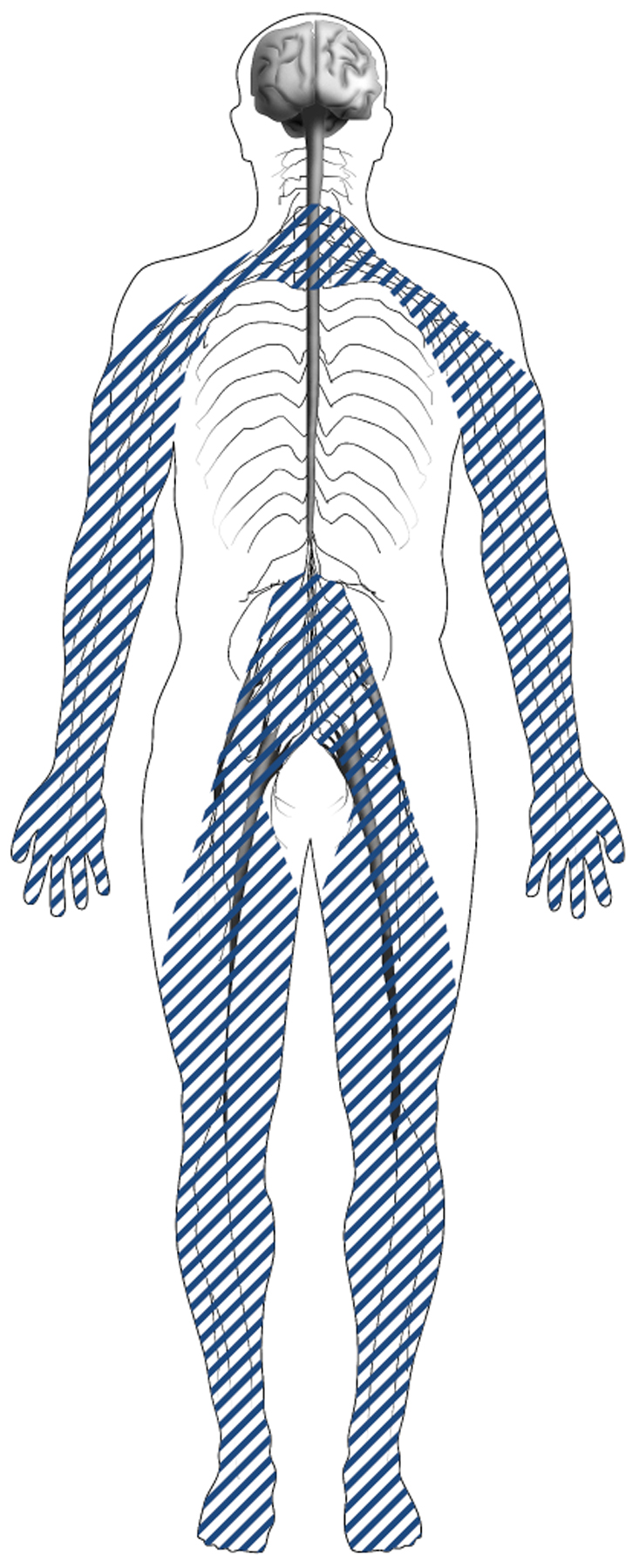
Illustration showing peripheral nerves of the arms and legs and areas where symptoms may appear. Source: NIDDK, NIH · Public domain use guidance
How does tingling from nerve compression differ from tingling caused by nerve damage?
The starting point for distinguishing these conditions is the distribution of the tingling and the conditions that change the symptoms. Consider whether the same areas on both sides are numb, whether the tingling follows a consistent path along a specific finger or leg, and whether changing the position of your back or limbs changes the symptoms. Combined with sensory, strength, and reflex testing to determine the actual extent of functional loss, along with the timing and speed of symptom onset, these factors help distinguish the type of damage (Watson JC et al., 2015).
Nerve root compression, or localized compression at the carpal tunnel of the wrist, the ulnar nerve at the elbow, or the tarsal tunnel of the ankle, often produces symptoms in the distribution of a single specific nerve on one side. The tingling may also be linked to postures or movements that put strain on that area. In contrast, with polyneuropathy, symmetric sensory abnormalities that can't be explained by posture alone are a key clue. Increased tingling and burning when lying down at night also point toward a nerve-related cause.
Localized compression can also occur on both sides, so symmetry alone isn't enough to draw a conclusion. Diabetic neuropathy and localized compression can also coexist. So even if you've already been diagnosed with a spine or wrist problem, if there's widespread sensory loss that the existing diagnosis doesn't explain, it's worth checking whether multiple peripheral nerves have been damaged.
If your calf hurts while walking but improves with rest, this should also be distinguished from vascular claudication caused by blood flow problems, which requires checking the pulses in your feet. If a blood flow problem is suspected, vascular testing and treatment addressing the underlying cause are needed. Because treatment differs depending on whether the issue is localized compression versus an underlying cause requiring combined treatment, this distinction should be made early if tingling has lasted several weeks.
New weakness or symptoms that spread rapidly over a period of weeks call for prompt evaluation. If breathing or swallowing difficulty or rapidly worsening gait problems occur alongside these symptoms, emergency evaluation is needed.
What can a nerve conduction study tell us?
A nerve conduction study applies electrical stimulation to peripheral nerves and records the speed of signal transmission and the size of the response. Needle electromyography (EMG) uses a thin needle electrode to record the electrical activity of muscles. At Guri Top Bone Clinic, a neurologist directly performs EMG and nerve conduction studies, combining the test results with sensory, strength, and reflex findings to distinguish localized compression from damage affecting multiple peripheral nerves.
These tests assess whether the damage primarily affects the axon (the "wire" inside the nerve that carries signals) or the myelin sheath (the insulation surrounding it), and how the changes are distributed across different nerves. Combining EMG findings with the duration of symptoms reported by the patient can also help estimate how the damage has progressed (Watson JC et al., 2015).
Some people have burning or tingling symptoms despite normal nerve conduction study results. This can happen because damage limited to the small sensory nerve fibers that carry pain and temperature sensation may not show up on standard nerve conduction studies. In these cases, a normal result doesn't rule out peripheral neuropathy — depending on symptoms and exam findings, small fiber neuropathy should be separately evaluated (Tesfaye S et al., 2010).
While nerve conduction studies show nerve function and the distribution of damage, blood glucose and hemoglobin A1c, vitamin B12, and kidney function tests help identify underlying causes such as elevated blood sugar or nutritional deficiency. Depending on the patient's history, thyroid function testing may also be added to help pinpoint which cause is damaging the nerves.
If compression at a specific location matches the symptoms, ultrasound-guided injection or nerve block treatment may be given there. If damage to multiple nerves is confirmed, treatment addresses the underlying cause along with pain medication.
Besides diabetes, what else can damage nerves?
Diabetes is the most common cause of peripheral neuropathy. Persistently elevated blood sugar and metabolic abnormalities can damage not only nerve cells but also the small blood vessels that supply them. Because of this, nerve damage may be progressing in someone with diabetes even when tingling symptoms are mild.
Screening for diabetic neuropathy begins at the time of diagnosis for type 2 diabetes, and 5 years after diagnosis for type 1 diabetes, with regular follow-up screening afterward. If tingling or reduced sensation has already developed, diagnostic evaluation of current symptoms is needed rather than waiting for the scheduled screening. The reason screening start times differ by diabetes type is to catch and manage nerve damage related to metabolic abnormalities early (Feldman EL et al., 2019).
Even without diabetes, prolonged excessive alcohol use, vitamin B12 deficiency, hypothyroidism (underactive thyroid), and reduced kidney function can be associated with nerve damage. Certain medications, including chemotherapy drugs, can also damage nerves, so the names of medications taken and the timing of symptom onset can offer clues to the cause.
Less commonly, immune-mediated conditions or hereditary causes may be involved. It helps to check whether family members have had similar symptoms and how those symptoms progressed, though in some cases a cause isn't identified even after a full evaluation (Watson JC et al., 2015). When a cause is found, confirmed deficiencies can be corrected, or the prescribing physician can be consulted about changing the type or dose of a suspected causative medication — so pain reduction and identifying the cause are pursued together.
If it's peripheral neuropathy, how is treatment carried out?
If diabetes is the cause, blood sugar is managed in coordination with internal medicine. If excessive alcohol use is involved, stopping drinking is recommended, and if a nutritional deficiency is confirmed, the missing nutrient is supplemented. If a medication is suspected as the cause, the prescribing physician is consulted about changing or adjusting the dose.
For people whose sleep is disrupted by burning or stabbing pain, neuropathic pain medications such as pregabalin or gabapentin may be selected. The treatment goal with these medications is reducing pain and the sleep disruption it causes. Dosing takes kidney function into account, and if drowsiness or dizziness occurs after starting the medication, the type or dose is adjusted. In diabetic neuropathy, blood sugar management and pain medication serve different roles (Callaghan BC et al., 2012).
At Guri Top Bone Clinic, the composition of vitamin and mineral nutritional infusions is determined after a clinical evaluation. If testing confirms a specific nutrient deficiency, replacing that nutrient is part of correcting the underlying cause, and patients with poor nutritional intake may receive infusions for nutritional support. These are also available during evening clinic hours.
If pain is concentrated and severe in one area, a nerve block guided by C-arm imaging to confirm needle placement may be added to reduce pain in that area.
People with reduced protective sensation in the feet may not notice quickly if their shoes rub or their skin gets burned. Check the skin on your feet daily for wounds or blisters, and wear well-fitting shoes. Because reduced ability to sense heat can lead to burns, avoid direct contact with hot compresses or electric heating pads on your feet. This kind of foot care is part of treatment aimed at reducing additional injury from reduced sensation and preserving function (Watson JC et al., 2015).
The speed at which pain improves and the speed at which numbness or muscle weakness recovers can differ. Pain that was disrupting sleep may improve first, while discomfort in the soles of the feet or with walking may persist. The extent of recovery depends on the cause and severity of the nerve damage. At follow-up visits, in addition to pain, changes in foot sensation, strength, and walking function are checked.
References
- Feldman EL, Callaghan BC, Pop-Busui R (2019). Diabetic neuropathy. Nat Rev Dis Primers. PMID: 31197153
- Watson JC, Dyck PJ (2015). Peripheral Neuropathy: A Practical Approach to Diagnosis and Symptom Management. Mayo Clin Proc. PMID: 26141332
- Tesfaye S, Boulton AJ, Dyck PJ (2010). Diabetic neuropathies: update on definitions, diagnostic criteria, estimation of severity, and treatments. Diabetes Care. PMID: 20876709
- Callaghan BC, Cheng HT, Stables CL (2012). Diabetic neuropathy: clinical manifestations and current treatments. Lancet Neurol. PMID: 22608666
Frequently Asked Questions
Q. Can nerve root compression cause foot tingling even without back pain?
Yes, nerve root compression can cause foot tingling even without noticeable back pain. Because the presence or absence of back pain alone doesn't determine the cause, the distribution of tingling, strength and reflex testing, and nerve conduction studies if needed are used together to identify where the damage is.
Q. If the hands tingle before the feet, does this call for a different evaluation than distal symmetric polyneuropathy?
Tingling that starts in the hands before the feet differs from the typical course of distal symmetric polyneuropathy, which usually progresses starting from the toes, so other causes should be checked. Depending on which fingers are affected and whether there's also sensory loss in the feet, this is distinguished from nerve compression at the wrist or elbow.
Q. If vitamin B12 levels are normal, is it still necessary to take additional supplements?
Having tingling symptoms alone isn't a reason to start additional vitamin B12 supplementation. However, if there's a dietary history or medical history suggesting possible deficiency, it's worth rechecking levels against testing criteria, and whether to supplement is decided based on any additional test results needed.
Q. If pain has improved but numbness in the feet remains, is it okay to stop the medication?
Reduced pain alone doesn't mean nerve function has fully recovered, and remaining numbness alone doesn't necessarily mean pain medication must be continued. Whether to reduce the dose is decided based on how much pain and sleep disruption have improved and whether side effects are present. Depending on the medication, doses may need to be tapered gradually, so medication should not be stopped on your own without medical guidance.