
Last updated: 2026-10-15
A Sharp Jolt at One Spot Beside My Sacrum When I Stand Up From Sitting
If one pinpoint spot beside your sacrum hurts when you stand up from sitting, and the numbness in your thigh does not travel below the knee, you should suspect sacroiliac joint pain. Sacroiliac joint syndrome is a condition in which pain develops in the joint that connects the sacrum and the ilium at the back of the pelvis and in the ligaments around it.
For example, a female patient in her 50s may describe a sharp jolt at one spot right beside her sacrum the moment she stands up from a chair after sitting for a long time, with the same spot hurting again when she climbs stairs. If the back of her thigh feels numb in this case but the numbness stays above the knee instead of reaching the calf, we look first at a problem in the joint at the back of the pelvis rather than at nerve root compression in the lower back.
With sacroiliac joint syndrome, you feel distinct tenderness when a finger presses the small hollow right beside the sacrum. The pain gets noticeably worse with movements that change how force is shared between the left and right sides of the pelvis, such as standing up from a chair, putting your weight on one leg, climbing stairs, or turning over in bed. Referred pain that starts here spreads to the buttock, groin, and thigh, but it usually does not travel below the knee (Cohen Steven P et al., 2013).
The sacroiliac joint is by nature a joint with little movement. It passes the heavy load of the upper body coming down the spine to both legs and keeps the pelvis stable (Gartenberg Andrew et al., 2021). When everyday load repeatedly leans toward one side, excessive stress builds up on the joint surfaces and on the ligaments that tightly bind the area around them, and pain develops. In fact, about 15–30% of patients whose low back pain is chronic and does not radiate into the leg are reported to have sacroiliac joint pain. The main related factors include a difference in length between the two legs, pregnancy and childbirth, trauma such as a fall, and a history of previous spine surgery (Cohen Steven P et al., 2013).
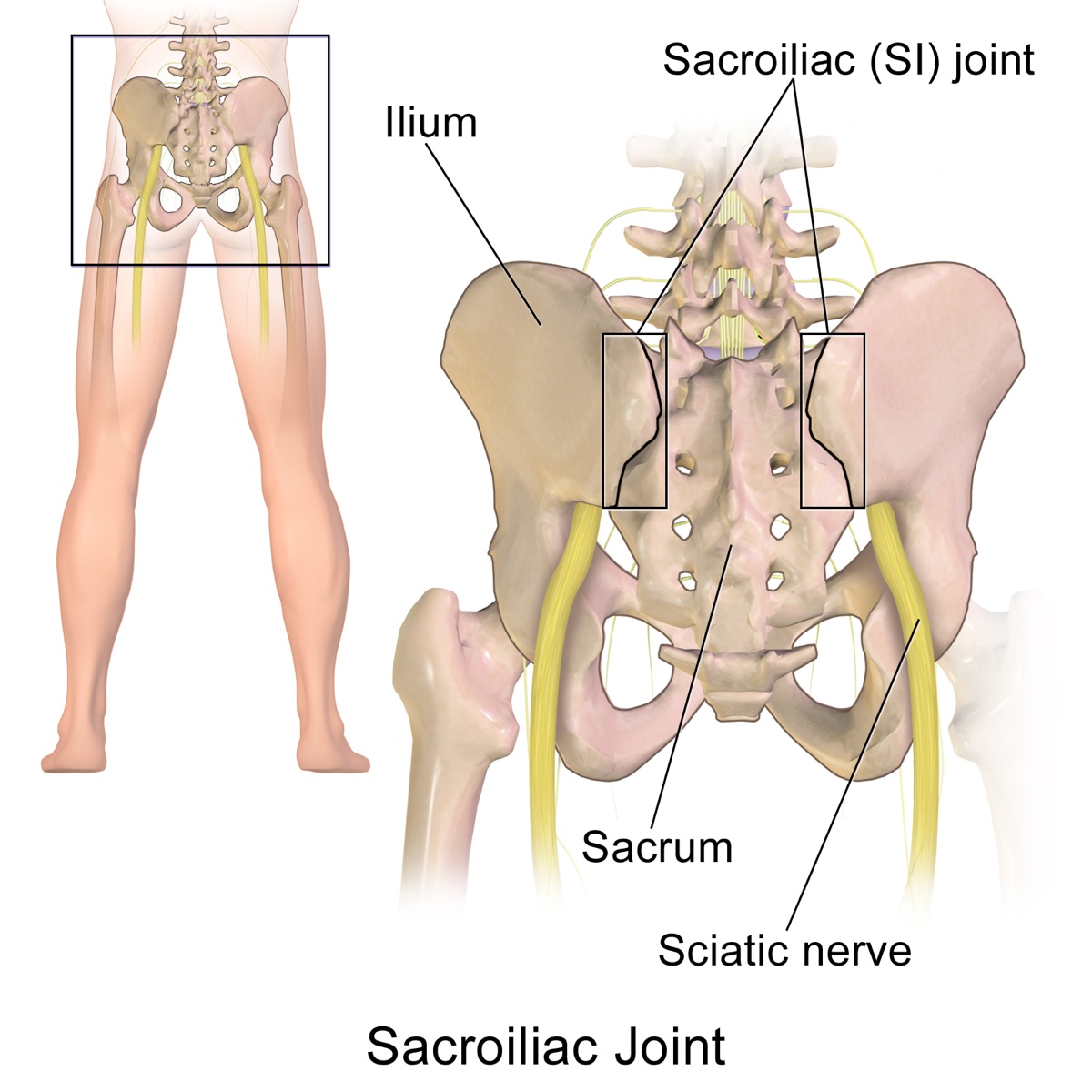 Sacroiliac joint viewed from the back of the pelvis: sacrum, pelvic bone, and sciatic nerve (BruceBlaus, CC BY 3.0)
If the Numbness Travels Down to the Calf or It Hurts Even at Night
Even when the sacral area aches and pulls, the underlying condition differs depending on how far the symptoms spread and which signs come with them. Referred pain from the sacroiliac joint can overlap with the symptoms of other causes of low back pain, so we tell them apart by combining the patient's history with the examination findings (Cohen Steven P et al., 2013). In particular, when we distinguish it from a lumbar nerve root problem, we examine the sensation and strength of the legs in detail.
If the numbness goes past the knee to the calf or the toes, or if sensation in the leg drops and the ankle loses strength, we first rule out nerve root problems caused by lumbar disc disease (the disc is the soft cushion between the vertebrae) or by spinal stenosis. If your legs go numb and hurt as if they will burst while you walk on level ground, so that you have to stop and rest, this too is a typical pattern of neurogenic claudication, which we cover in Spinal Stenosis: Leg Numbness and Nerve Compression.
Axial spondyloarthritis, which includes ankylosing spondylitis, is a chronic inflammatory disease that mainly affects the sacroiliac joints and the spine (Navarro-Compán Victoria et al., 2025). If pain in the sacral area and lower back wakes you in the middle of the night, or if stiffness lasts a long time after you get up in the morning, this kind of inflammatory back pain has to be ruled out. In that case, the diagnosis is made by combining clinical examination findings, blood tests, and imaging findings of the sacroiliac joints (Navarro-Compán Victoria et al., 2025). On the other hand, if sudden, severe sacral pain appears together with fever or chills, causes including infection must be checked promptly.
What Can Pressing and Spreading the Pelvis on the Exam Table Reveal?
To find the cause of sacral pain, at Guri Top Bone Clinic we press directly on the painful spot beside the sacrum and perform provocation tests that apply force to the pelvis in several directions. Through these tests, we check whether the pain starts in the sacroiliac joint. This cluster of tests, done on the exam table, includes pressing the sides of the pelvis inward from both sides, spreading the front of the pelvis apart to both sides, pushing the thigh from above down toward the table while you lie on your back, and bending the leg into a figure-4 position and pressing on it.
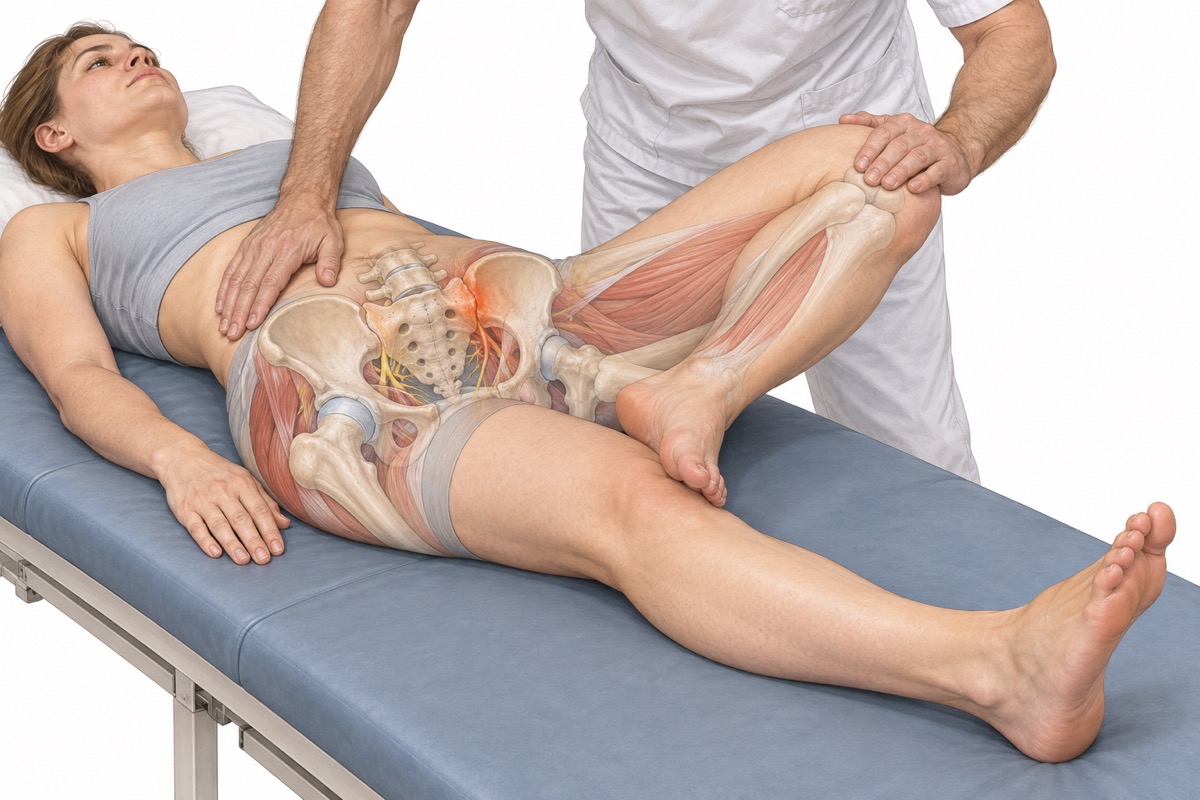 A provocation test that checks for sacroiliac joint pain by placing one ankle over the opposite knee and pressing on the knee and pelvis (AI-generated illustration)
With each maneuver, we put physical stress on the joint surfaces of the pelvis and check whether the same pain the patient usually feels in daily life appears. When pain is reproduced in three or more of these provocation tests, it becomes an important clue for predicting the response to the sacroiliac joint diagnostic injection that follows (Cohen Steven P et al., 2013).
According to a meta-analysis that assumed a 20% prevalence of sacroiliac joint pain, when the provocation test cluster was positive, the probability of actually having sacroiliac joint pain was about 35%. When the cluster was negative, that probability fell to about 8% (Saueressig Tobias et al., 2021). In other words, the physical examination is useful for screening out cases that are not joint problems and for picking out the patients who need a detailed evaluation as the next step.
We also use ultrasound to look at the sacroiliac joint and the tissues around the buttock. However, in sacroiliac joint complex pain, it is hard to pin down the cause of the pain from imaging findings alone. So we use imaging as information for assessing the structural condition of the joint and the surrounding tissues, and we judge where the pain actually comes from by interpreting the examination findings together with the response to injection (McCormick Zachary L et al., 2025).
Why We Check on a Screen Whether the Needle Has Reached Inside the Joint
In the sacroiliac joint, the gap between two rough, curved bones is very narrow and lies deep beneath the skin. According to a medical review of sacroiliac joint injection techniques, injecting by feeling for the bones by hand without imaging equipment reached the inside of the joint with low accuracy, and fluoroscopic guidance, which shows real-time X-ray images, placed the needle inside the joint more accurately than ultrasound guidance (Bresnahan John J et al., 2022).
For this reason, at Guri Top Bone Clinic we confirm on the C-arm fluoroscopy screen that the needle has reached inside the sacroiliac joint and then perform the nerve block. Injections placed while watching images in this way are widely used to evaluate deep joint pain and to treat it without surgery (Gartenberg Andrew et al., 2021).
If your usual sacral pain clearly decreases after an accurate injection into the joint, this is an objective diagnostic clue that the pain comes from that joint (McCormick Zachary L et al., 2025).
How Is It Treated When the Ligaments Outside the Joint and the Buttock Muscles Also Hurt?
Sacroiliac joint complex pain does not arise only in the space inside the joint where the two bones meet. It can also arise in the outer ligaments that hold the joint firmly from behind so that it does not shift. According to international consensus practice guidelines, pain inside the joint and pain in the ligaments outside it occur about equally often (McCormick Zachary L et al., 2025). And non-surgical treatment is applied first as the first-line treatment for sacroiliac joint dysfunction (Gartenberg Andrew et al., 2021).
When the outer tissues that support the joint are the problem, at Guri Top Bone Clinic we perform proliferative and regenerative injection therapy (prolotherapy) on the stretched, overloaded ligaments around the sacroiliac joint. During the procedure, we check the location of the damaged or loosened ligament on ultrasound while injecting that area. When the buttock fascia around the joint has stayed tense for a long time and become stiff and painful, we use extracorporeal shockwave therapy (ESWT), and we provide manual therapy in which a therapist works on the alignment of the pelvis and spine by hand.
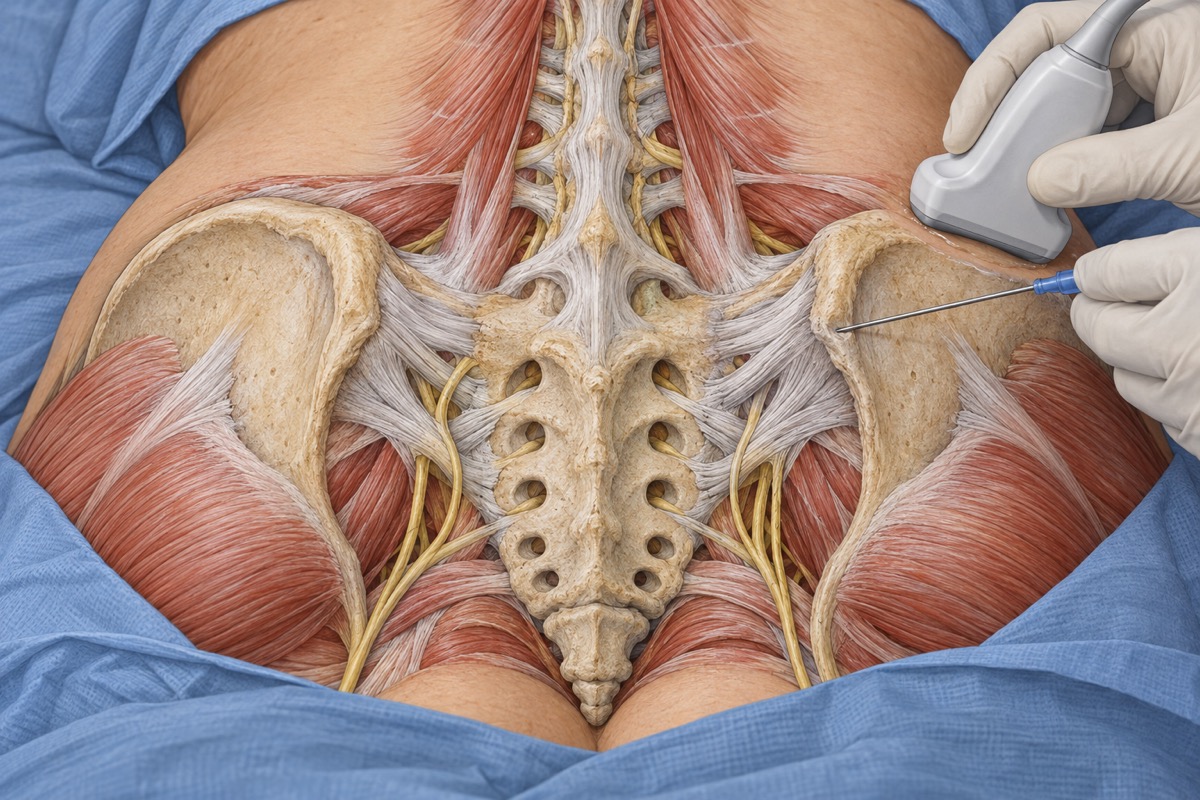 Illustration of an injection into the posterior ligament connecting the sacrum and pelvic bone, guided by ultrasound (AI-generated illustration)
When we plan treatment in this way, we combine several non-surgical treatments according to exactly where it hurts, whether inside the joint, in the surrounding ligaments, or in the buttock fascia, and how much movement is limited. Alongside treatment, habits in daily life that shift load onto one side of the pelvis, such as standing with your weight on one leg, crossing your legs while sitting, or carrying a heavy bag on only one shoulder, need to be corrected to reduce the renewed strain on the joint and ligaments.
Sung-Woog Lee · Medical Director · Board-Certified Neurologist · Guri Top Bone Clinic
References
- Cohen Steven P, Chen Yian, Neufeld Nathan J (2013). Sacroiliac joint pain: a comprehensive review of epidemiology, diagnosis and treatment.. Expert Rev Neurother. PMID: 23253394
- Gartenberg Andrew, Nessim Ari, Cho Woojin (2021). Sacroiliac joint dysfunction: pathophysiology, diagnosis, and treatment.. Eur Spine J. PMID: 34272605
- Navarro-Compán Victoria, Sepriano Alexandre, Capelusnik Dafne (2025). Axial spondyloarthritis.. Lancet. PMID: 39798984
- Saueressig Tobias, Owen Patrick J, Diemer Frank (2021). Diagnostic Accuracy of Clusters of Pain Provocation Tests for Detecting Sacroiliac Joint Pain: Systematic Review With Meta-analysis.. J Orthop Sports Phys Ther. PMID: 34210160
- McCormick Zachary L, Hurley Robert W, Anitescu Magdalena (2025). Consensus practice guidelines on sacroiliac joint complex pain from a multispecialty, international working group.. Pain Med. PMID: 41318933
- Bresnahan John J, Ng Andrew T (2022). Review of Sacroiliac Joint Injection Techniques.. Curr Pain Headache Rep. PMID: 35239155
Frequently Asked Questions
Q. What symptoms should I describe when I see a doctor for numbness above the knee?
Organizing when the numbness started, how far it spreads, and which of sitting, standing up, or walking makes it worse helps tell the causes apart. Even if the numbness stays above the knee, you should also mention it if sensation feels dulled or your leg loses strength.
Q. If a different spot than usual hurts during a sacroiliac joint provocation test, should I mention it?
You should describe specifically whether the location and feeling of the pain during the test are the same as your usual sacral pain or different. At Guri Top Bone Clinic, we record separately whether your usual pain is reproduced and whether other areas are tender, and we decide which areas to examine further.
Q. How should I record changes in pain after a sacroiliac joint injection?
Recording how strong the pain was before and after the injection, when the change began, and when the pain came back helps at your next visit. Also record how much easier the everyday movements that used to hurt, such as sitting down and standing up, have become.
Q. If the pain at one spot in my sacral area has decreased after the injection but my buttock still feels tight, what should I do?
Describing separately where the pain has decreased and where the tightness remains helps decide the next area to treat. At Guri Top Bone Clinic, we examine the tenderness and muscle tension in the remaining area and decide whether treatment of the ligaments or fascia around the joint is needed.