
Last updated: 2026-09-21
Why Does the World Spin Only When You Roll Over in Bed?
If the world briefly spins and then stops right after you roll over in bed, and this keeps happening, the first thing to notice is that changing your body's position and a brief spinning sensation go together. When everything around you spins each time you turn your head in a certain direction or lie down and sit up, ordinary movements become something you approach cautiously. This pattern is often caused by a problem in the vestibular organ deep inside the ear.
The utricle, part of the vestibular organ, holds tiny calcium carbonate crystals called otoconia that detect the body's tilt and acceleration. The trouble starts when these crystals dislodge from their normal position and flow into one of the three semicircular canals, which sense head rotation. When the head moves, the dislodged crystals push against the endolymph fluid inside the canal and stimulate the sensory cells, and the brain interprets this as a rotation signal far larger than the actual movement.
Vertigo caused this way starts suddenly after a few seconds' delay following a change in position, and in most cases it gradually fades within a minute (Kim Ji-Soo et al., 2014). Rolling over in bed, bending down to tie a shoelace, and tilting the head back to look at a high shelf are typical triggering movements, and nausea or an urge to vomit can accompany the episode (Cole Shayna R et al., 2022).
After the spinning sensation subsides, the intense vertigo goes away, but a mild lingering unsteadiness — a foggy or floating feeling whenever the head moves — can remain for a while. Among the three semicircular canals, the posterior canal, which is most susceptible to gravity, is involved most often, followed by the horizontal canal. When the otoconia stick to the cupula (the sensory receptor) instead of moving freely within the canal, the vertigo can continue for more than a minute while the head stays turned. If new hearing loss, a feeling of ear fullness, or tinnitus appears alongside these symptoms, another inner ear condition may be present in addition to the crystal displacement, and that possibility should be checked as well.
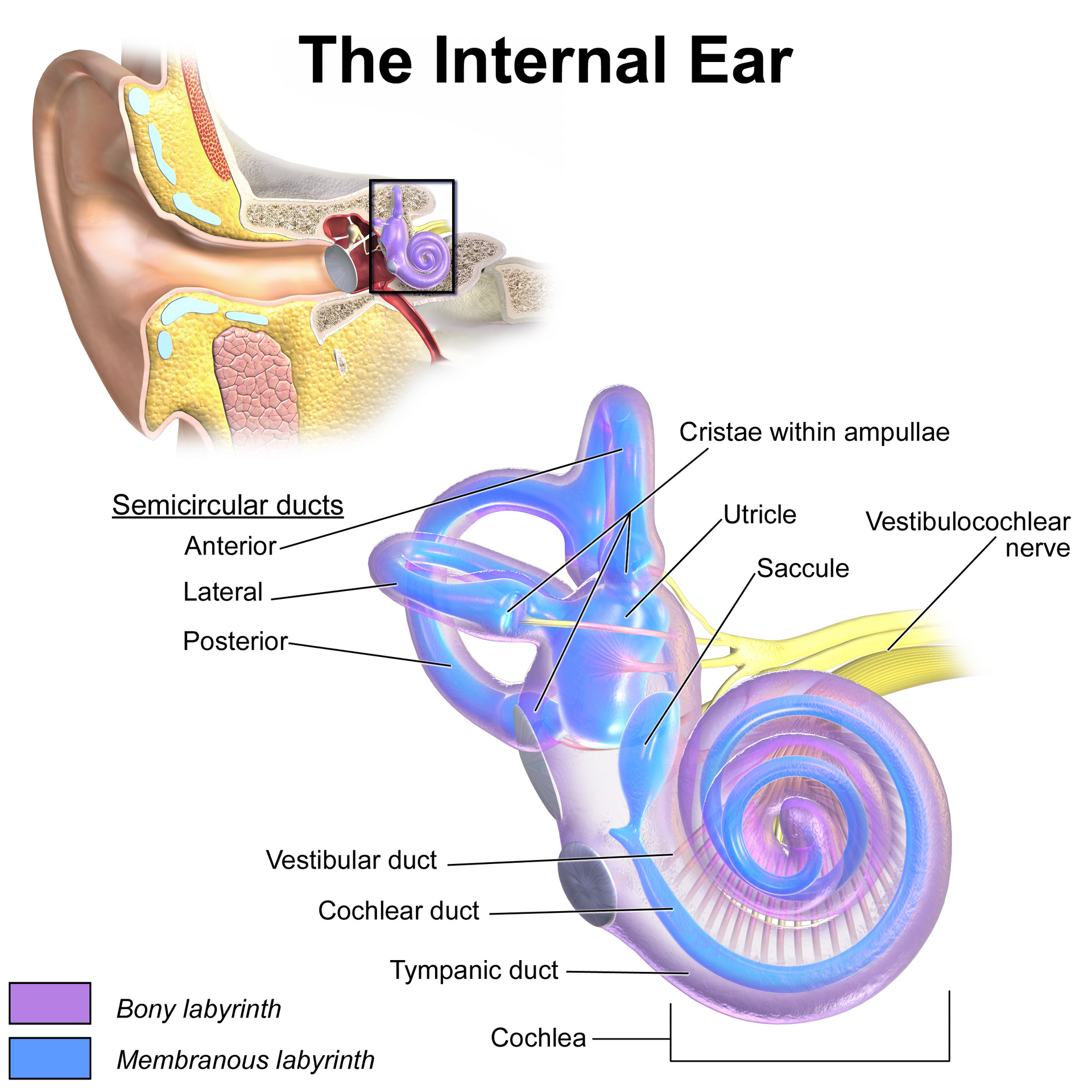
Structure of the inner ear — the three semicircular canals, otolith organs (utricle and saccule), and cochlea (Blausen.com staff, Medical gallery of Blausen Medical 2014, CC BY 3.0)
How Do Dizziness from the Ear and Dizziness from the Brain Differ, Even Though They Feel the Same?
Dizziness that resolves within a minute of changing position doesn't automatically point to the ear as the cause. Problems in the central nervous system structures that control balance, such as the brainstem or cerebellum, can also trigger or worsen dizziness with changes in posture (Lemos João et al., 2022). So rather than relying only on how long the patient's dizziness lasts, the exam also checks the direction of nystagmus — the eye-jerking pattern that appears when the patient takes a certain position — how long it takes for the response to start, and any other neurological signs.
Central positional nystagmus, seen with cerebellar or brainstem lesions or with vestibular migraine, can also begin with specific positions. Still, its signs differ from those of ear-based BPPV (benign paroxysmal positional vertigo). If pure downbeat nystagmus appears — the eyes keep beating downward even though the patient isn't looking down — or if the eye-jerking pattern doesn't match the neural pathway of the semicircular canal being stimulated, a brain problem is suspected first.
The direction of eye-jerking changing with the direction the head turns doesn't confirm a brain disorder either. Horizontal semicircular canal BPPV can also produce nystagmus that shifts direction — beating toward the floor or toward the ceiling — when the patient lies down and turns their head side to side. Telling an ear problem apart from a brain problem requires looking not just at this single directional shift but also at how long the nystagmus lasts and how quickly it fades (Kerber Kevin A, 2021).
If dizziness occurs along with double vision, slurred speech, choking when swallowing water, weakness in one arm or leg, or difficulty walking straight, a central disorder including stroke may be responsible, and the patient should seek emergency care right away. A central cause can still remain even without these accompanying symptoms. That's why neurologists distinguish a problem in the ear's vestibular organ from a problem in the brain's neural pathways by examining the detailed pattern of nystagmus together with a neurological exam.
What Does Video Nystagmography Check?
Video nystagmography is a test that records the eye's minute involuntary movements, or nystagmus, using goggles fitted with an infrared camera (Bhattacharyya Neil et al., 2017). When you look at an object in a bright environment, visual fixation suppresses the eye's involuntary tremor. Because the goggles darken the field of view and block this fixation, the test can pick up subtle nystagmus that the naked eye would miss.
The test proceeds by changing the position of the head and upper body in stages. Starting from a seated position, you turn your head to one side, then are quickly laid back so the head drops slightly below the level of the table. In this Dix-Hallpike test, if a brief latency is followed by upbeating, torsional nystagmus with the eyes rolling upward, the diagnosis is posterior canal BPPV (Bhattacharyya Neil et al., 2017). If the clinical history is clear but this test shows no response, or instead produces horizontal nystagmus beating side to side, a supine head-roll test — turning the head left and right while lying down — is added to check whether otoconia are lodged in the horizontal semicircular canal (Kerber Kevin A, 2021).
You don't need to be experiencing dizziness when you walk into the exam room. Changing position provokes the latent nystagmus, revealing the cause on the spot. However, BPPV comes and goes intermittently, so the absence of nystagmus on a single test does not rule it out. Rapidly changing head position during the test may briefly bring on intense spinning sensations or nausea.
Starting two days before the test, stop taking anti-vertigo drugs, motion-sickness drugs, and sedatives, since they mask the eye's response. Don't stop them on your own — just let the clinic know beforehand. You should also fast for four hours before the test and avoid eye makeup and contact lenses. At Guri Top Bone Clinic, video nystagmography uses camera goggles and position changes to record the direction and duration of nystagmus, distinguishing whether dizziness originates from the ear (vestibular system) or the brain (central nervous system). A neurologist performs the test personally and explains the results. If a central (brain) cause is suspected, cerebral blood flow ultrasound is added; if dizziness occurs only on standing, autonomic function testing is added; and if there has been a seizure or a change in consciousness, an EEG is added. When the findings meet the diagnostic criteria for BPPV and no other neurological abnormalities are present, imaging is not routinely recommended, and the patient is referred for detailed imaging when central signs appear.
How Much Evidence Supports Canalith Repositioning?
When otoconia crystals are found rolling around inside a semicircular canal, a repositioning maneuver — moving the head and body in a specific sequence to guide the crystals back to their original location, the utricle — is recommended as the first-line treatment (Bhattacharyya Neil et al., 2017). Video nystagmography is used to determine which ear and which semicircular canal contains the crystals, and the maneuver is chosen based on that finding. The Epley maneuver or Semont maneuver is used for posterior canal BPPV, the most common form, while the barbecue roll maneuver is used for horizontal canal involvement.
The effectiveness of repositioning maneuvers has been consistently confirmed across studies. A Cochrane systematic review pooled 11 randomized controlled trials involving 745 participants. Among the 5 trials (273 participants) that compared resolution of vertigo, 56% of patients who received the Epley maneuver had their vertigo resolve, compared with 21% in the sham-maneuver or no-treatment groups. The odds ratio was 4.42 (Hilton Malcolm P et al., 2014). These figures reflect outcomes observed within the study populations.
No serious adverse events were reported in the studies reviewed. During the head-turning portion of the maneuver, sudden nystagmus accompanied by nausea occurred in roughly 16.7% to 32% of patients. Anyone who has difficulty extending or rotating the neck due to cervical spine disease, or difficulty turning the body quickly due to spine or hip disease, should first have their joint range of motion examined. The speed and manner of the maneuver are then adjusted based on that assessment.
The older practice of keeping patients sitting upright for several days after the maneuver is no longer recommended in current guidelines. Vestibular suppressants such as antihistamines or benzodiazepines can slow the brain's vestibular compensation, so they are not used as a primary long-term treatment; they are reserved for short-term use only when vomiting is severe enough to make the maneuver difficult to tolerate. Once testing confirms posterior canal BPPV, treatment proceeds with the repositioning maneuver, or the patient is referred to a facility that performs it.
What Should Be Checked If Dizziness Returns After a Repositioning Maneuver?
If dizziness returns after treatment, the first step is to determine whether it is an unresolved condition that has lingered since right after the procedure, or a true recurrence that developed after a period of feeling fine. Guidelines recommend reassessing within one month of observation or treatment to check whether symptoms have fully resolved (Bhattacharyya Neil et al., 2017). This is because otolith crystals that the previous treatment failed to fully reposition may remain, or the crystals may have shifted into a different semicircular canal while the head was turning.
A Cochrane review found that recurrence occurred in 36% of cases during the follow-up period after repositioning maneuvers (Hilton Malcolm P et al., 2014). Even when recurrence occurs, repeating the positional provocation test to reconfirm the affected semicircular canal and performing the same repositioning maneuver again often brings improvement.
If rotational vertigo persists despite repeated repositioning maneuvers, the diagnosis needs to be reconsidered from scratch. The otolith crystals may not have fully resolved, another peripheral vestibular condition such as vestibular neuritis or Ménière's disease may be present alongside it, or a central cause such as vestibular migraine or a brainstem lesion may only reveal itself later. In such cases, cerebral blood flow ultrasound is performed as well, and a referral for detailed imaging is made if needed.
When the crystals return to their proper position and the acute spinning sensation resolves, but a lingering unsteadiness — a sense that the floor is swaying — remains, vestibular rehabilitation exercises can be added to help restore the sense of balance. Older adults face a higher risk of falls and fractures while their balance is temporarily impaired. It is safer to keep a night light on around the bed for nighttime trips to the bathroom, and to rely on help from those nearby rather than walking alone when feeling dizzy.
Sung-Woog Lee · Medical Director · Board-Certified Neurologist · Guri Top Bone Clinic
References
- Kim Ji-Soo, Zee David S (2014). Clinical practice. Benign paroxysmal positional vertigo.. N Engl J Med. PMID: 24645946
- Cole Shayna R, Honaker Julie A (2022). Benign paroxysmal positional vertigo: Effective diagnosis and treatment.. Cleve Clin J Med. PMID: 36319052
- Lemos João, Strupp Michael (2022). Central positional nystagmus: an update.. J Neurol. PMID: 34669008
- Kerber Kevin A (2021). Episodic Positional Dizziness.. Continuum (Minneap Minn). PMID: 34351110
- Bhattacharyya Neil, Gubbels Samuel P, Schwartz Seth R (2017). Clinical Practice Guideline: Benign Paroxysmal Positional Vertigo (Update).. Otolaryngol Head Neck Surg. PMID: 28248609
- Hilton Malcolm P, Pinder Darren K (2014). The Epley (canalith repositioning) manoeuvre for benign paroxysmal positional vertigo.. Cochrane Database Syst Rev. PMID: 25485940
Frequently Asked Questions
Q. Can dizziness continue all day even after a brief episode of rotational vertigo ends?
Mild lightheadedness or a sense of unsteadiness can remain after a brief spinning sensation stops. However, if the surroundings keep spinning continuously for an entire day, this is not treated as a residual symptom of BPPV, and other causes are investigated.
Q. Can I still have the positional provocation test if I can't tilt my neck back well?
If tilting your head back is difficult, the test can be carried out with an adjusted posture, such as lying on your side. Let the provider know beforehand about any neck or back conditions, or past treatment for them, so they can check your range of motion and safety before deciding on the testing method.
Q. If BPPV recurs, can I perform the repositioning maneuver I learned before on my own?
If you have been taught the conditions and technique for a self-repositioning maneuver, you may perform it within the scope you were instructed. However, with recurrence the affected ear or semicircular canal may differ from before, so if your symptoms or the position that triggers vertigo differ from the previous episode, or if you have a neck or lower back condition, you should be examined before performing the maneuver.
Q. If BPPV symptoms resolve on their own, can I just watch and wait without treatment?
If you have been diagnosed with BPPV and your symptoms are decreasing, watchful waiting may be an option, on the condition that you continue follow-up monitoring. However, if you have a high risk of falling or your symptoms interfere with daily life, whether to start treatment is decided rather than waiting for the symptoms to settle on their own.